


L to R: “Balustrade Relief Vase 6-94,” 1994. 62 x 47 x 9 in / “Balustrade Relief Vase 97-01,” 1997. 72 x 53 x 8 3/4 in / “Balustrade Relief Vase 96-11,” 1996. 68 1/2 x 74 x 9 in / “Balustrade Relief Vase 96-2,” 1996. 68 x 73 x 10 in / “Balustrade Relief Vase 03-3,” 2003. 48 x 110 x 9 1/2 in / Installation view, "Betty Woodman,” Museo Marino Marini, Florence, Italy, 2015. Woodman Family Foundation Archives / “Of Botticelli,” 2013. 10 1/2 ft x 32 ft x 3/4 in / “Wallpaper: 16,” 2017. 112 x 209 x 1 in / "Wallpaper: 19,” 2017. 65 x 59 in / “Outside and In,” 2017. 75 1/2 x 120 x 10 1/2 in. Images 1-9: All artworks glazed earthenware, epoxy resin, lacquer, and paint / Image 10: Glazed earthenware, epoxy resin, lacquer, paint, canvas, and wood. 1-4: Courtesy of David Kordansky Gallery. Photo: Phoebe d’Heurle. All artworks by Betty Woodman © Woodman Family Foundation / Artists Rights Society (ARS), New York
Betty Woodman. “Balustrade Relief Vase 6-94,” 1994. 62 x 47 x 9 in. Glazed earthenware, epoxy resin, lacquer, and paint © Woodman Family Foundation / Artists Rights Society (ARS), New York. Courtesy of David Kordansky Gallery. Photo: Phoebe d’Heurle.
Betty Woodman's "Balustrade Relief Vases," 1990s: "Betty Woodman: Conversations on the Shore, Works from the 1990s," David Kordansky Gallery, New York, New York, 2022
The Balustrade Relief Vases, which Betty Woodman began making in the 1990s, were a turning point in her work, in which she fully embraced the space and concerns of painting, through sculptural materials.

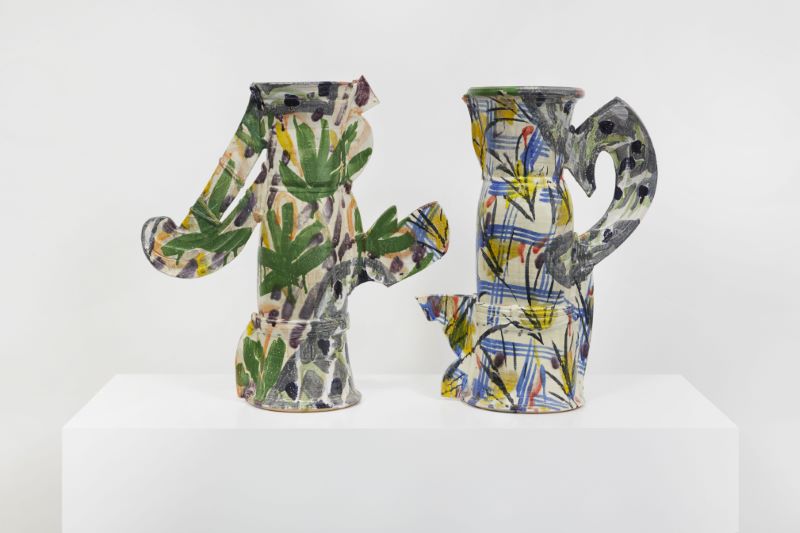
L to R: 1-2: “Kimono Vases: January” or "Kimono Vases: 2," 1995. 28 1/2 x 45 x 9 3/4 in / “Untitled Diptych,” c. 1994. 28 1/2 x 51 x 8 1/2 in / “Seashore,” 1998. 25 3/4 x 57 x 8 1/2 in / “Green Nude,” 2007. 33 x 33 3/4 x 6 3/4 in / “After the Bath,” 2011. 35 x 37 x 7 in / Images 7-8: “Fair Welcome and Pleasure,” 2008. 33 x 78 1/4 x 7 1/2 in / Images 9-10: “Kabuki Diptych,” 2016. 35 x 67 x 8 in. All artworks glazed earthenware, epoxy resin, lacquer, and paint. © Woodman Family Foundation / Artists Rights Society (ARS), New York
Betty Woodman. “Kimono Vases: January” or "Kimono Vases: 2," 1995. 28 1/2 x 45 x 9 3/4 in. Glazed earthenware, epoxy resin, lacquer, and paint © Woodman Family Foundation / Artists Rights Society (ARS), New York
Betty Woodman's "Kimono Vases" and "Diptychs," 1990s: "Betty Woodman: Conversations on the Shore, Works from the 1990s," David Kordansky Gallery, New York, October 29-December 17, 2022
"The evolution of the Kimono Vases began with three-part vases, or triptychs. I thought about the movement from one piece to another; in and out of the negative and positive shapes so that it ultimately became one. The triptychs got bigger and the handles became flat, more abstract and complicated,” Betty Woodman wrote in 1991.


L to R: Installation view, Max Protetch Gallery, New York, New York, 1986 / “Pillow Pitcher: Persian Silk,” 1982. 19 x 23 x 13 in. Collection of Philadelphia Museum of Art, Philadelphia, Pennsylvania / “Pesce Spada,” 1989. 11 x 26 x 21 in / “Indonesian Napkin Holder,” 1984. 18 1/2 x 22 1/2 x 10 in. Collection of Museum of Arts and Design, New York, New York / “Vase and Shadow: Muscle Boys and Shadows,” 1984. 17 x 45 x 13 in / “Shelf and Vase: Gentian,” 1986. 27 x 16 x 8 in / Installation view, “The Art of Betty Woodman,” The Metropolitan Museum of Art, New York, New York, 2006. Photo: Eli Ping. All artworks glazed earthenware, epoxy resin, lacquer, and paint. Image 2: Courtesy of Philadelphia Museum of Art, Philadelphia, Pennsylvania. All artworks by Betty Woodman © Woodman Family Foundation / Artists Rights Society (ARS), New York
Betty Woodman. Installation view, Max Protetch Gallery, New York, New York, 1986. Woodman Family Foundation Archives.
Betty Woodman works from the 1980s: "Betty Woodman: Conversations on the Shore, Works from the 1990s," David Kordansky Gallery, New York, New York, 2022
Betty Woodman began her career as a potter, inspired by a Bauhaus ethos to make beautiful objects for people to use in their daily lives. By 1980, when she and her husband George Woodman—a painter and photographer—purchased the New York City loft where they lived and worked for part of each year until the end of their lives, she had already begun moving away from the purely functional concerns of ceramics.

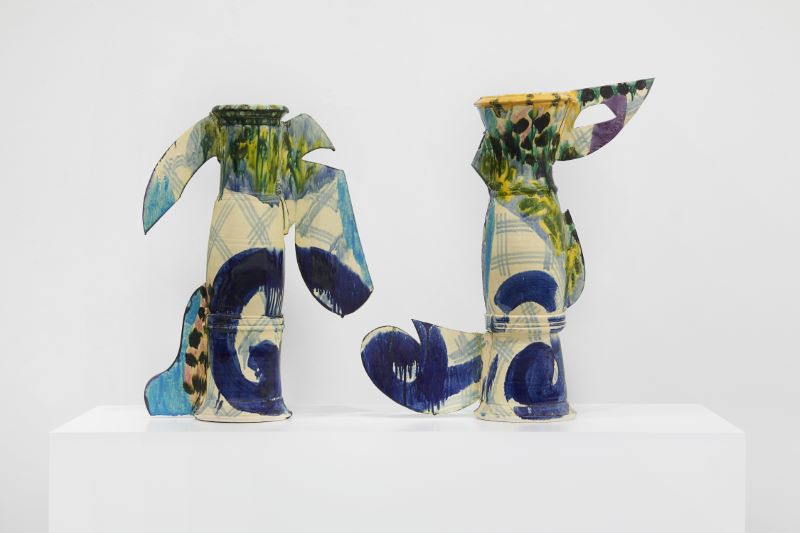
L to R: “Kimono Vases: October,” 1990. 30 3/4 x 43 x 9 1/2 in / “Still Life Vase: 9,” 1990. 31 1/2 x 30 x 8 in / “Double Vase Diptych,” 1996. 30 x 43 1/2 x 9 in / “Two Women Vase Diptych,” 1996. 24 x 44 x 6 in / “Beccafumi Vase Triptych,” 1996. 33 1/2 x 74 1/2 x 10 1/2 in / “Balustrade Relief Vase: 97-01,” 1997. 72 x 53 x 8 3/4 in. All artworks glazed earthenware, epoxy resin, lacquer, and paint. 1, 2 & 6: Courtesy of David Kordansky Gallery. Photo: Phoebe d’Heurle. All artworks by Betty Woodman © Woodman Family Foundation / Artists Rights Society (ARS), New York
Betty Woodman. “Kimono Vases ‘October’,” 1990. 30 3/4 x 43 x 9 1/2 in. © Woodman Family Foundation / Artists Rights Society (ARS), New York. Courtesy of David Kordansky Gallery. Photo: Phoebe d'Heurle.
Betty Woodman reviews from the 1990s: "Betty Woodman: Conversations on the Shore, Works from the 1990s," David Kordansky Gallery, New York, New York, 2022
The 1990s was a career-defining period for Betty Woodman in which her work in ceramic declared itself as painting and sculpture through her radical formal innovations. This shift was affirmed by contemporary art critics, who increasingly discussed her work in relation to sculpture and painting of the day.


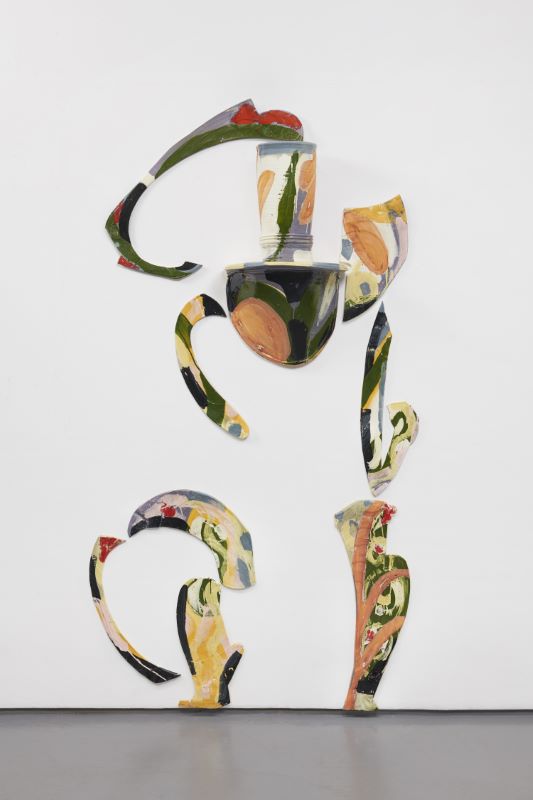
L to R: All artworks Betty Woodman. "House of the South," 1994-1996. 159 x 246 x 9 1/2 in. Glazed earthenware, epoxy resin, lacquer, and paint / Images 1-2: Installation view, "Betty Woodman," Stedelijk Museum, Amsterdam, The Netherlands, 1996 / Images 3: Installation view, "Betty Woodman,” Musée d’Art Contemporain, Dunkerque, France, 1997 / Images 4-5: Installation view, “Betty Woodman,” Fundação Calouste Gulbenkian, Lisbon, Portugal, 1997 / Image 6: Installation view, “The Art of Betty Woodman,” The Metropolitan Museum of Art, New York, New York, 2006. Photo: Eli Ping / Image 7: Installation view, "Strange Clay: Ceramics in Contemporary Art," Hayward Gallery, London, England, 2022. Photo: Mark Blower. Courtesy of the Hayward Gallery. Images 1-6: Woodman Family Foundation Archives.
Installation view, "Betty Woodman," Stedelijk Museum, Amsterdam, The Netherlands, 1996. Woodman Family Foundation Archives.
Betty Woodman's "House of the South," 1994-1996 in "Strange Clay: Ceramics in Contemporary Art," Hayward Gallery, London, England, 2023
Betty Woodman’s touring exhibition which began at the Stedelijk in 1996 also included another major work: “House of the South” (1994-1996). Measuring more than 13 feet high by more than 20 feet wide, this ambitious frieze evolved from Woodman’s “Balustrade Relief Vase” series begun earlier in the decade, here incorporating multiple three-dimensional vases atop ceramic shelves, surrounded by flat ceramic relief elements implying architecture, plants and other vessels.


L to R: Images 1, 3, 5: Installation view, "Betty Woodman," Stedelijk Museum, Amsterdam, The Netherlands, 1996. Woodman Family Foundation Archives / Image 2: “Women at the Fountain,” 1992. 86 x 144 x 57 in. Collection of the Flemish Community, Belgium / Image 4: “Conversations on the Shore,” 1994. 84 x 160 x 41 in / Image 6: “Sala da Pranzo,” 1995. 25 1/4 x 32 x 10 in. All artworks glazed earthenware, epoxy resin, lacquer, and paint / Image 7: Installation view, "Betty Woodman,” Musée d’Art Contemporain, Dunkerque, France, 1997. Images 4 & 6: Courtesy of David Kordansky Gallery. Photo: Phoebe d’Heurle. All artworks by Betty Woodman © Woodman Family Foundation / Artists Rights Society (ARS), New York
Installation view, "Betty Woodman," Stedelijk Museum, Amsterdam, The Netherlands, 1996. Woodman Family Foundation Archives.
"Betty Woodman," Stedelijk Museum, Amsterdam, The Netherlands, 1996: "Betty Woodman: Conversations on the Shore, Works from the 1990s," David Kordansky Gallery, New York
In September of 1996, the Stedelijk Museum in Amsterdam opened “Betty Woodman,” a major exhibition of the artist’s work and her largest in Europe at that point. The works on view included two installations—“Women at the Fountain” (1992) and “Conversations on the Shore” (1994)—in which Woodman for the first time combined free-standing vases on the floor with an array of wall-mounted vases and flat ceramic elements.

L to R: “Balustrade Relief Vase: 52,” 1992. 82 x 45 x 10 in / “Athens,” 1991. 35 1/2 x 69 x 10 in / “Seashore,” 1998. 26 x 59 x 9 in. All artworks glazed earthenware, epoxy resin, lacquer and paint. All images Courtesy of David Kordansky Gallery. Photo: Phoebe d’Heurle. All artworks by Betty Woodman © Woodman Family Foundation / Artists Rights Society (ARS), New York
Betty Woodman. “Balustrade Relief Vase: 52,” 1992. 82 x 45 x 10 in. Glazed earthenware, epoxy resin, lacquer and paint © Woodman Family Foundation / Artists Rights Society (ARS), New York. Courtesy of David Kordansky Gallery. Photo: Phoebe d’Heurle.
ON VIEW: "Betty Woodman: Conversations on the Shore, Works from the 1990s," David Kordansky Gallery, New York, New York, 2022
This major solo exhibition—the first of the artist’s work in New York in six years—brings together a group of ceramic sculptures from a critical and career-defining period in Woodman’s practice.
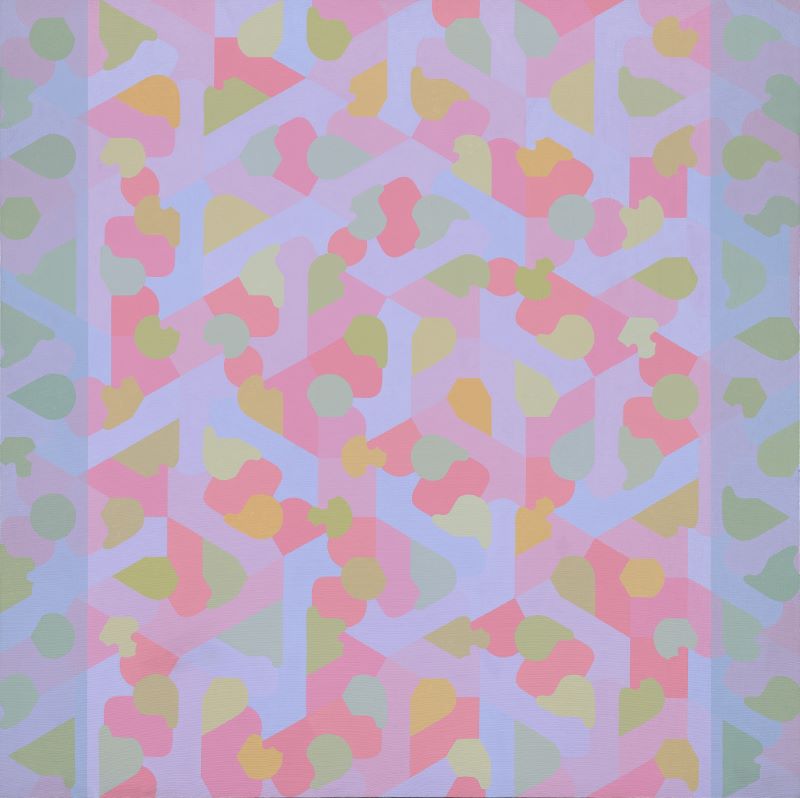
L to R: George Woodman. “Beauty is Truth,” 1976. 52 x 52 in. Acrylic on canvas. Image courtesy RISD Museum | Francesca Woodman. “Charlie the Model #10,” 1976, 5 5/16 x 5 3/8 in. Lifetime gelatin silver print | Betty Woodman. “Pillow Pitcher: Rain Forest,” c. 1980s. 20 x 24 x 16 in. Glazed earthenware © Woodman Family Foundation / Artists Rights Society (ARS), New York
George Woodman. “Beauty is Truth,” 1976. 52 x 52 in. Acrylic on canvas © Woodman Family Foundation / Artists Rights Society (ARS), New York. Image courtesy RISD Museum.
RISD Museum Acquisitions
We’re thrilled that RISD Museum has acquired a group of important works by Betty, Francesca, and George Woodman from the Foundation’s holdings through a combination of museum funds and Foundation gifts.


Betty Woodman. “Portuguese Baroque,” 2013, 18 1/4 x 25 x 8 1/2 in. Glazed earthenware, epoxy resin, lacquer, paint © Woodman Family Foundation / Artists Rights Society (ARS), New York
ON VIEW: Betty Woodman in "Women's Work," Lyndhurst Mansion, Tarrytown, New York, 2022
Betty Woodman in “Women’s Work,” Lyndhurst Mansion, Tarrytown, New York. On view through September 26, 2022.

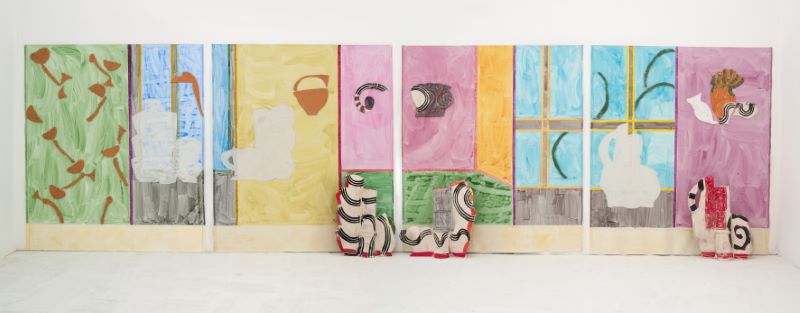
Betty Woodman. Installation view and details, "Alessandro’s Rooms," 2011. 102.5 x 354.5 x 15.75 in. Glazed earthenware, epoxy resin, lacquer, acrylic paint, canvas © Woodman Family Foundation / Artists Rights Society (ARS), New York
Betty Woodman. "Alessandro’s Rooms," 2011. 102.5 x 354.5 x 15.75 in. Glazed earthenware, epoxy resin, lacquer, acrylic paint, canvas © Woodman Family Foundation / Artists Rights Society (ARS), New York
ON VIEW: Betty Woodman in "The Flames: The Age of Ceramics" at Musee d'Art Moderne de Paris, Paris, France, 2021
"The Flames" takes a transhistorical approach to ceramics to assert the critical relationship of clay to both art and humankind. The exhibition combines ancient objects dating back to the Neolithic with those made by contemporary artists—including Betty Woodman—and everything in between.

Envelope for letter from George Woodman in Boulder, Colorado to Francesca Woodman in Rome, Italy, October 19, 1977. Woodman Family Foundation Archives.
ON VIEW: Betty Woodman, Francesca Woodman, and George Woodman in “Interior Scroll or What I Did on My Vacation” at S&S Corner Shop, The Art Building, Springs, New York, 2021
We are pleased to announce that this exhibition includes a selection of correspondence written between Betty, Francesca and George Woodman in 1978, as well as Francesca Woodman’s “Selected Video Works,” 1976-1978.
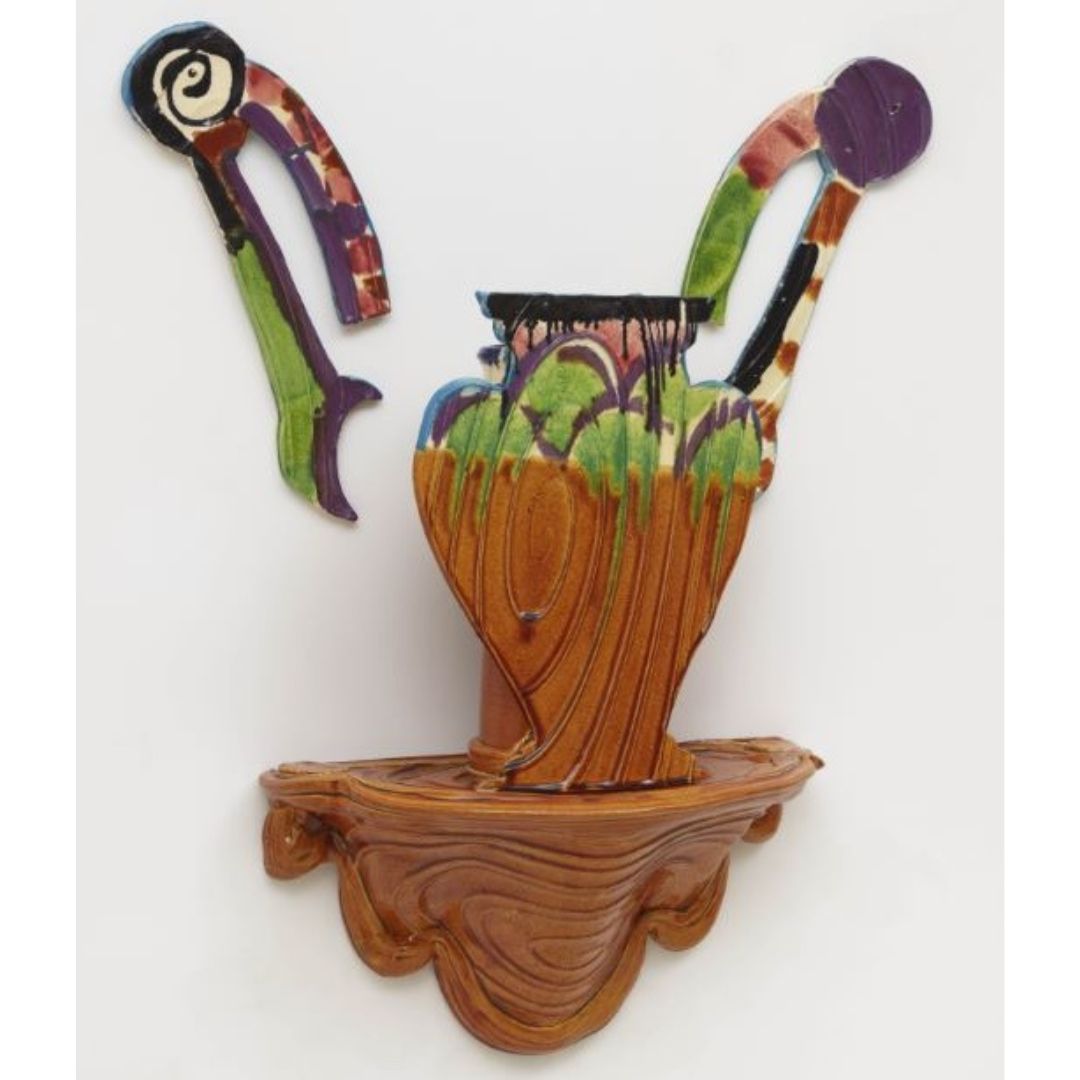
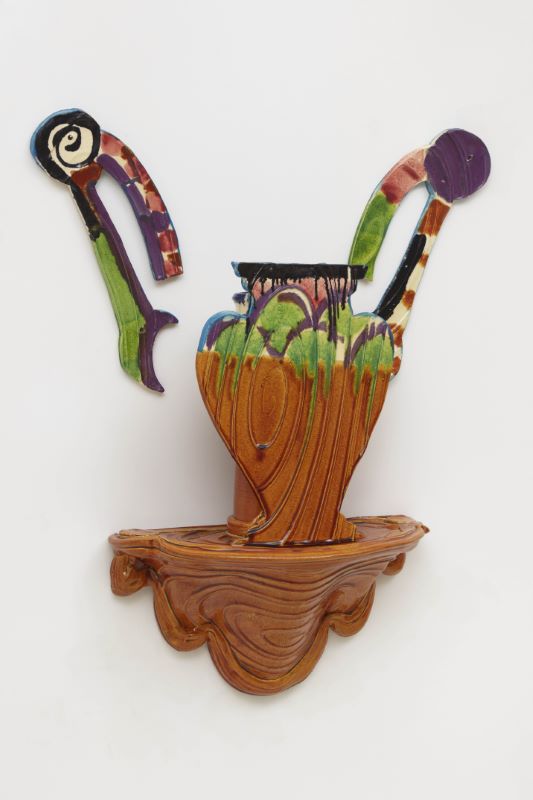
Betty Woodman. “Shelf and Vase: Zante,” 1985. 31 x 21 x 9 in. Glazed earthenware, epoxy resin, lacquer, acrylic paint © Woodman Family Foundation / Artists Rights Society (ARS), New York
ON VIEW: Betty Woodman in “With Pleasure: Pattern and Decoration in American Art 1972-1985” at Hessel Museum of Art, Bard College, Annandale-on-Hudson, New York, 2021
This ambitious exhibition, curated by Anna Katz, brings together American artists, including Betty Woodman, associated with the Pattern and Decoration movement in the first such comprehensive and scholarly survey. The exhibition showcases painting, sculpture, collage, ceramics, installation and performance which embraced craft-based and decorative traditions and approached art-making from a sometimes dizzying appreciation of historic sources and feminist aesthetics.