


L to R: George Woodman. “285” or “Bari” or “Winterreise”, 1975, 65 x 65 in. Acrylic on canvas | Francesca Woodman. “Untitled”, c. 1975-78, 6 5/8 x 6 9/16 in. Gelatin silver print | Betty Woodman. “Joined Vases”, 1972, 11 1/2 x 23 x 10 in. Porcelain | Francesca Woodman. “Untitled”, c. 1979-80, 11 x 14 in. Gelatin silver print | George Woodman. “Study in White: Marble from Michelangelo’s Quarry”, 2004, 16 x 20 in. Gelatin silver print | Betty Woodman. “Boys”, 2013, 28 x 28 x 7 in. Glazed earthenware | George Woodman. “Untitled”, 1974, 84 x 84 in. Acrylic on canvas | Detail from Betty Woodman. “Aeolian Pyramid”, 2001/2006, approx. 150 x 168 x 100 in. Glazed earthenware, epoxy resin, lacquer, paint | George Woodman. “Tessellation Sky”, 1975, 54 1/2 x 54 1/2 in. Acrylic on canvas | Betty Woodman. “Nina’s Room”, 2012, 86 x 107 x 12 1/2 in. Glazed earthenware, epoxy resin, lacquer, acrylic paint, canvas | Francesca Woodman. “Untitled”, c. 1977-78, 3 13/16 x 3 7/8 in. Gelatin silver print | Betty Woodman. “Judith’s Window”, 2012, 59 1/2 x 43 1/2 x 10 1/2 in. Glazed earthenware, epoxy resin, lacquer, acrylic paint, canvas, wood | Francesca Woodman. “Untitled”, 1980, 8 1/2 x 8 1/2 in. Gelatin silver print | Betty Woodman. “Divided Vases: Window”, 2012, 33 1/4 x 42 x 7 1/2 in. Glazed earthenware, epoxy resin, lacquer, paint | Francesca Woodman. “Untitled”, 1976, 5 1/8 x 5 1/8 in. Gelatin silver print | George Woodman. “Untitled”, c. 1980, dimensions unknown. Acrylic on canvas | Francesca Woodman. “Untitled”, c. 1979-80, 3 7/8 x 5 5/8 in. Gelatin silver print | Francesca Woodman. “Untitled,” c. 1979-80, 5 1/2 x 5 5/8 in. Gelatin silver print | George Woodman. “Christening Dress and Roman Sculpture (A Roman Fragment with a Christening Dress)”, 2011, 42 x 38 1/2 in. Oil on gelatin silver print | Betty Woodman. “White Amphoras”, 2004, 33 x 57 x 12 in. Glazed earthenware. All artworks © Woodman Family Foundation / Artists Rights Society (ARS), New York
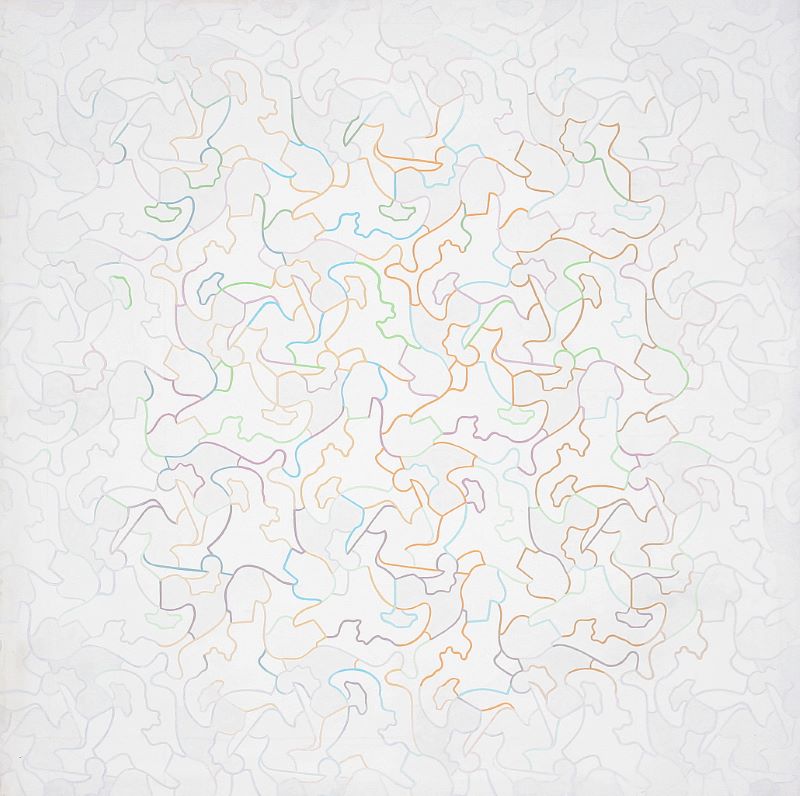
George Woodman. “285” or “Bari” or “Winterreise”, 1975, 65 x 65 in. Acrylic on canvas © Woodman Family Foundation / Artists Rights Society (ARS), New York
The Woodmans and the use of white
Betty Woodman and George Woodman are often celebrated for their exuberant use of color, while Francesca Woodman is best known for her dramatic black-and-white photographs, filled with shades of grey. Working across different mediums and methods, the Woodman artists used white—and the absence of color—to fascinating effects.

L to R: 1-3, 5, 6: Installation views, “An Interior Exchanged,” Fashion Institute of Technology, New York, New York, 1982. Woodman Family Foundation Archives | 4: Spread from “Wallpapers for Historic Buildings” by Richard C. Nylander, The Preservation Press, Washington, D.C., 1983 | 7: Betty Woodman, “Cloistered Arbor Room,” 1981, 10 x 23 ft. Glazed earthenware, epoxy resin, lacquer, fabric. Installation view from “The Elizabeth Reed Keller Memorial Exhibition: Ceramics,” Suzanne Lemberg Usdan Gallery, Bennington College, Bennington, Vermont, 1981 | 8: Betty Woodman, “Bedroom with Lattice,” 2009, 92 x 85 x 15 in. Glazed earthenware, paint, canvas | 9: Spread from “Pompei ercolano stabile oplontis: le città sepolte dal Vesuvio” by Pietro Giovanni Guzzo, Electa Napoli, Italy, 2003 | 10: Betty Woodman, “Villa Oplontis,” 2006, 45 x 121 x 11 in. Terra sigillata, canvas, glazed earthenware, epoxy resin, lacquer, wood | 11: Betty Woodman, “Il Giardino Dipinto,” 1993, 9 x 35 ft. Glazed earthenware, epoxy resin, lacquer, paint. Installation view from “Betty Woodman: Il Giardino Dipinto,” Rhode Island School of Design Museum, Providence, Rhode Island, 2005 | 12: Selected books on wall paintings, wallpapers, and architecture from Betty Woodman’s collection | 13: Betty Woodman, “Wallpaper: 11,” 2016, 120 x 144 in. Glazed earthenware, epoxy resin, lacquer, acrylic paint. All Betty Woodman artworks © Woodman Family Foundation / Artists Rights Society (ARS), New York
Installation view, “An Interior Exchanged,” Fashion Institute of Technology, New York, New York, 1982. Woodman Family Foundation Archives
Betty Woodman's collaboration with Cynthia Carlson and her pivot to the wall
In the spring of 1981, Betty Woodman and Cynthia Carlson started planning for “An Interior Exchanged,” an environmental collaboration presented in ARTISANSPACE at the Fashion Institute of Technology in 1982.

L to R: 1: Betty Woodman, “Ceramic Pictures of Korean Paintings: Rose Lattice Tree Vase, Tiger Lily Tree Vase, Evergreen Tree Vase, Lotus Tree Vase, Camellia Tree Vase,” 2001/2002, 37.5 x 10 x 1 ft. Glazed earthenware, clay, canvas | 2: Installation view, “Betty Woodman,” Daum Museum of Contemporary Art, Sedalia, Missouri, 2002 | 3, Pair: Detail from Betty Woodman, “Cactus, Lotus, and Butterfly,” 2005 / Page from “Korean Art Book Vol. 6: Minhwa I” by Yoon Yeol-soo, Yekyung Publishing, Korea, 2000 | 4: Betty Woodman, “Cactus, Lotus, and Butterfly,” 2005, 120 x 90 x 12 in. Glazed earthenware, canvas | 5, Pair: Page from “Korean Art Book Vol. 6: Minhwa I” / Detail from Betty Woodman, “Cartoon of Roman Paintings: Santa Brigida,” 2005 | 6: Betty Woodman, “Cartoon of Roman Paintings: Santa Brigida,” 2005, 98 x 86 in. Terra sigillata, ink and wax on paper | 7, Pair: Detail from Betty Woodman, “Cartoon of Roman Paintings: Santa Brigida,” 2005 / Page from “Korean Art Book Vol 7: Minhwa II” by Yoon Yeol-soo, Yekyung Publishing, Korea, 2000 | 8: Spread from “Korean Art Book Vol 6: Minhwa I” with handwritten note by Betty Woodman | 9: Betty Woodman, “Siena: Ceramic Pictures of Korean Vases,” 2004, 96 x 84 x 9 1/2 in. Glazed earthenware, clay, canvas | 10: “Korean Art Book” volumes 1, 2, 6, 7, from Betty Woodman’s collection. All Betty Woodman artworks © Woodman Family Foundation / Artists Rights Society (ARS), New York
Betty Woodman, “Ceramic Pictures of Korean Paintings: Rose Lattice Tree Vase, Tiger Lily Tree Vase, Evergreen Tree Vase, Lotus Tree Vase, Camellia Tree Vase,” 2001/2002, 37.5 x 10 x 1 ft. Glazed earthenware, clay, canvas © Woodman Family Foundation / Artists Rights Society (ARS), New York
Betty Woodman and works inspired by Korean folk painting
On a trip to South Korea in 2001, Betty Woodman was introduced to the Joseon Dynasty folk art (minhwa)—with motifs like vibrant scenes of peonies and lotuses. With these paintings in mind, she started a new series of wall-based works titled “Ceramic Pictures of Korean Paintings,” which she first showed at the Daum Museum in 2002 as a five-panel mural.

Photos, L to R: Betty Woodman in her New York studio, c. 1983 | Francesca Woodman, c. 1979-80. Photo: George Woodman | George Woodman in front of his paper tile installation, 1979 Woodman Family Foundation Archives. Artwork and photo by George Woodman © Woodman Family Foundation / Artists Rights Society (ARS), New York
Graphic with text: "WFF Housing Stability Grant for Artists / 3-year rent subsidies for 5 visual artists in NYC"
Announcing the WFF Housing Stability Grant for NYC-based visual artists
In recognition of the increasing unaffordability of rental housing in New York City and the housing insecurity it creates for artists, WFF will award grants of $30,000—distributed over three years—to five visual artists with the goal of improving their housing stability.

L to R: Group, T to B: Betty Woodman, “Athens,” 1991, 35 1/2 x 68 5/8 x 10 1/4 in. Glazed earthenware, epoxy resin, lacquer, and paint / George Woodman, “Untitled,” c. 1966-68, 39 1/2 x 39 1/2 in. Acrylic on canvas / Francesca Woodman, “After My Grandmother's Funeral,” 1977, from the “After My Grandmother's Funeral” series, 5 1/8 x 5 1/4 in. Gelatin silver print | Betty Woodman, “Athens,” 1991, 35 1/2 x 68 5/8 x 10 1/4 in. Glazed earthenware, epoxy resin, lacquer, and paint | George Woodman, “Untitled,” c. 1966-68, 39 1/2 x 39 1/2 in. Acrylic on canvas | Francesca Woodman, “After My Grandmother's Funeral” series, 1977. Gelatin silver prints | Francesca Woodman, “After My Grandmother's Funeral,” 1977, from the “After My Grandmother's Funeral” series, 5 1/8 x 5 1/4 in. Gelatin silver print | Francesca Woodman, “After My Grandmother's Funeral,” 1977, from the “After My Grandmother's Funeral” series, 5 1/8 x 5 1/8 in. Gelatin silver print | Francesca Woodman, “Untitled,” 1977, from the “After My Grandmother's Funeral” series, 5 5/16 x 5 1/4 in. Gelatin silver print | Francesca Woodman, “After My Grandmother's Funeral,” 1977, from the “After My Grandmother's Funeral” series, 5 x 5 1/8 in. Gelatin silver print | Francesca Woodman, “After My Grandmother's Funeral,” 1977, from the “After My Grandmother's Funeral” series, 5 1/8 x 5 1/8 in. Gelatin silver print | Francesca Woodman, “2,” 1977, from the “After My Grandmother's Funeral” series, 5 1/4 x 5 1/4 in. Gelatin silver print All artworks © Woodman Family Foundation / Artists Rights Society (ARS), New York.
Group, T to B: Betty Woodman, “Athens,” 1991 / George Woodman, “Untitled,” c. 1966-68 / Francesca Woodman, “After My Grandmother's Funeral,” 1977, from the “After My Grandmother's Funeral” series © Woodman Family Foundation / Artists Rights Society (ARS), New York.
Acquisition by the Currier Museum of Art, Manchester, New Hampshire, 2024
We are very pleased to announce the acquisition of a group of important works by Betty Woodman, Francesca Woodman, and George Woodman from the Foundation’s holdings by the Currier Museum of Art in Manchester, New Hampshire.

L to R: 1: Betty Woodman, “Wallpaper,” 2013, 84 x 120 in. Glazed earthenware, epoxy resin, lacquer, acrylic paint | 2, 9: Page from “The Cut-Outs of Henri Matisse” | 3: Betty Woodman, “Orange Rug with Clay Bones,” 2013, 105 1/4 x 47 x 1 in. Earthenware, canvas, acrylic paint | 4: Detail from Henri Matisse, “Oceania, the Sea,” 1948, 68 1/8 × 152 1/2 in. Linen, plain weave; screen printed. Produced by Zika Ascher, Ltd. Art Institute of Chicago. | 5: Detail from “Orange Rug with Clay Bones,” 2013 | 6: Betty Woodman, “Balustrade Relief Vase 05-1,” 2005, 55 x 48 x 9 in. Glazed earthenware, epoxy resin, lacquer | 7: Betty Woodman, "Outside and In," 2017, 75 1/2 x 120 x 10 1/2 in. Glazed earthenware, epoxy resin, lacquer, acrylic paint, canvas, wood | 8: Betty Woodman, “House of the South,” 1994-1996, 159 x 246 x 9 1/2 in. Glazed earthenware, epoxy resin, lacquer, paint. Installation view from “The Art of Betty Woodman,” Metropolitan Museum of Art, New York, New York, 2006 | 10: "The Cut-Outs of Henri Matisse” by John Elderfield, New York: George Braziller, 1978, from Betty Woodman’s collection. All Betty Woodman artworks © Woodman Family Foundation / Artists Rights Society (ARS), New York. All Henri Matisse artworks © Succession H. Matisse / Artists Rights Society (ARS), New York
Betty Woodman, “Wallpaper,” 2013, 84 x 120 in. Glazed earthenware, epoxy resin, lacquer, acrylic paint © Woodman Family Foundation / Artists Rights Society (ARS), New York
Betty Woodman's works and Matisse's cut outs
Betty Woodman's eclecticism reflects a wide array of influences, including those from modernist French painters like Gauguin, Bonnard, and Matisse. Yet Woodman’s connection to Matisse transcends their shared use of vivid, exuberant colors. Both artists indulged in decorative impulses through their inventive use of positive and negative space.

Image details: 1. Betty Woodman at work in her studio in Antella, Italy, 1996. Photograph by George Woodman | 2. An assemblage of Betty Woodman’s studio materials. Clockwise from bottom left: Rocket Expansion cement, broken ceramic pieces, measuring cup, sponges, Orton standard pyrometric cones (open box) Orton small pyrometric cones, fork, toothbrush, kitchen knife | 3. George Woodman in his New York City studio c. 1980s | 4. An assemblage of George Woodman’s studio materials. Clockwise from bottom left: Gorton vapor equalizing valve, Bessey vise clamp, Xcemite screw driver, rubber hook tool, Dap silicone, GE silicone, Stanley level, Conair hair dryer, Wiss pliers, Great Neck wood chisel, Maimeri set of paints
Betty Woodman at work in her studio in Antella, Italy, 1996. Photograph by George Woodman. Woodman Family Foundation Archives.
Tools used by Betty Woodman and George Woodman
October is American Archives Month and we are celebrating by looking at some of the tools of the trade used by George Woodman and Betty Woodman in our collection.

L to R: 1: Betty Woodman. “Edo Fashion Ladies,” 2006, glazed earthenware, 34 1/2 x 32 1/2 x 7 in. | 2: Page from “Fashion of Edo: Women's Dress in Ukiyo-e Paintings 1989." Japan Institute of Arts and Crafts, 1989 | 3 & 7: Betty Woodman. “After the Bath,” 2011, glazed earthenware, epoxy resin, lacquer, acrylic paint, 35 x 37 1/2 x 8 in. | 4: Pair: Detail from Betty Woodman, “After the Bath” / Ippitsusai Bunchō, “Kagiya Osen,” from “Japanese Prints” by Gabriele Fahr-Becker, Barnes & Noble Inc., 2003 | 5: Detail from Betty Woodman, “After the Bath” | 6: Ishikawa Toyonobu, “After the Bath,” page from “Japanese Prints” by Gabriele Fahr-Becker | 8: Spread from “Edo Chiyogami” by Hirose Tatsugoro, Seigensha, 2002 | 9: “Fashion of Edo: Women's Dress in Ukiyo-e Paintings 1989." Japan Institute of Arts and Crafts, 1989, with torn page | 10: Selected publications on Japanese art from Betty Woodman’s collection All Betty Woodman artworks © Woodman Family Foundation / Artists Rights Society (ARS), New York.
Betty Woodman. “Edo Fashion Ladies,” 2006, glazed earthenware, 34 1/2 x 32 1/2 x 7 in. © Woodman Family Foundation / Artists Rights Society (ARS), New York
Betty Woodman’s books on Japanese textiles and woodblock prints
Over the past few months, the Foundation delved into Betty Woodman's and George Woodman’s personal library as part of our ongoing work to build a study center. Betty Woodman’s books on Japanese textiles and woodblock prints, in particular, are extensively bookmarked, with pages cut and ripped away by the artist. She often amassed many of these books on her travels regardless of whether she could read the language, choosing instead to let the images weave themselves into her visual lexicon.

L to R: Pair: “Athens,” 1991 / “Massenet,” ed. 8/8, 2010 | “Athens,” 1991, Glazed earthenware, epoxy resin, lacquer, and paint. 35 1/2 x 68 5/8 x 10 1/4 in. | “Massenet,” ed. 8/8, 2010, Soft-paste porcelain biscuit. © Sèvres - Manufacture et musée nationaux, 2013.D.8587.1 / 20013.D.8587.2. Photographer: Gerard Jonca. All works by Betty Woodman © Woodman Family Foundation / Artists Rights Society (ARS), New York
Pair: “Athens,” 1991 / “Massenet,” ed. 8/8, 2010. Works by Betty Woodman © Woodman Family Foundation / Artists Rights Society (ARS), New York
ON VIEW: New Betty Woodman exhibitions, September 2024
This month, explore two group exhibitions in New York showcasing diverse works by Betty Woodman from the 1990s and 2000s.

L to R: Betty, Charles, and Francesca Woodman in front of the New York World's Fair Unisphere, 1964 / Charles and Francesca Woodman in front of Thailand's pavilion, 1964 / Bird's eye view of the New York World's Fair, 1964. Woodman Family Foundation Archives.
Betty, Charles, and Francesca Woodman in front of the New York World's Fair Unisphere, 1964. Woodman Family Foundation Archives.
The Woodmans at the 1964 New York World's Fair
Sixty years ago, before they had traveled much of the world together, the Woodman family visited the 1964-1965 New York World’s Fair in Flushing Meadows-Corona Park.

Betty Woodman. "Wall Vase," c. 1980s, approx. 25 1/2 x 14 1/2 x 7 in. Glazed earthenware © Woodman Family Foundation / Artists Rights Society (ARS), New York.
"Betty Woodman: Images of Function” by Layaan Roufai
We are pleased to share “Betty Woodman: Images of Function” by Layaan Roufai, who was our Library & Archives intern this summer through the Studio Institute Arts Intern program.

Detail: Betty Woodman walking under torii gates, Japan, 1990 / Pair: Details of Betty Woodman and George Woodman in a traditional ryokan inn, Japan, 1990 / Betty Woodman, Japan, 1990 / George Woodman, Japan, 1990 / George Woodman, Shinto shrine, Japan, 1990 / Hōryū-ji Temple, Nara, Japan, 1990 / Buddhist Guardian statue, Hōryū-ji Temple, Nara, Japan, 1990 / Pillars, Hōryū-ji Temple, Nara, Japan, 1990 / Shave ice stall, Japan, 1990. Woodman Family Foundation Archives.
Detail: Betty Woodman walking under torii gates, Japan, 1990. Woodman Family Foundation Archives.
Betty Woodman and George Woodman in Japan, 1990
As the solstice today marks the official beginning of summer, we are reminded of the Woodmans’ extensive travels around the world and their months immersed in global artistic influences.