


L to R: 1, 15: George Woodman, installation view of "George Woodman: Paintings 1962-1963," Henderson Gallery, University of Colorado, Boulder, Colorado | 2, 6, 10, 12-13: Installation view of "George Woodman: Paintings 1962-1963," Henderson Gallery, University of Colorado, Boulder, Colorado | 3: “End of the Alphabet,” c. 1963, 52 x 52 in. | 4: “The Magic Box,” c. 1963, 55 x 45 in. | 5: “Landscape (After the Death of Adonis),” 1963, 72 x 72 in. | 7: “Untitled,” c. 1962-63, dimensions unknown. | 8: “Cleopatra (With Asp),” c. 1963, 48 x 51 in. | 9: “April Cool” or “Buddhist Shrine” or “Diamond Gestalt,” 1963, 70 x 70 in. | 11: “Love is a Bridge,” c. 1963, 52 x 52 in. | 14: “Mid-West Landscape (With Fallout)," 1963, 48 x 80 in. All oil on canvas. All artworks by George Woodman © Woodman Family Foundation / Artists Rights Society (ARS), New York. Woodman Family Foundation Archives.
George Woodman, installation view of "George Woodman: Paintings 1962-1963," Henderson Gallery, University of Colorado, Boulder, Colorado. Woodman Family Foundation Archives.
George Woodman in "George Woodman: Paintings 1962-1963," Henderson Gallery, University of Colorado, Boulder, Colorado
In December of 1963, George Woodman opened an exhibition of his recent paintings at the Henderson Gallery at University of Colorado, Boulder, where he also taught painting and philosophy of art.

L to R: 1: Still Life Vase in kiln, Boulder, Colorado, 1991 | 2: Betty and kiln, Boulder, Colorado, March 1970 | 3: Betty and kiln, Boulder, Colorado, May 1965 | 4: “Folded Tri-part Vase,” 1975, 8 x 25 x 8 in. Salt glazed stoneware | 5: Betty and kiln, Boulder, Colorado, c. 1960s | 6: Kiln, Antella, Italy, c. 1990s | 7: Kiln, Antella, Italy, c. 1996 | 8: Kiln, Antella, Italy, c. 1990s | 9: Betty and kiln, Antella, Italy, c. 1990s | 10: Betty and George firing the kiln, Antella, Italy, c. 1973 | 11: “Pillow Pitcher: Italian,” 1977, 15 x 30 x 15 in. Terra sigillata | 12: Betty and kiln, Antella, Italy, c. 1960s | 13: Betty and kiln, Antella, Italy, c. 1969 | 14: “Fabric Samples” in progress in kiln, New York, New York, 2005 | 15: “Fabric Samples,” 2005, 30 x 31 x 8 in. Glazed earthenware. Installation view from “The Art of Betty Woodman,” Metropolitan Museum of Art, New York, New York, 2006 | 16: Ceramic fragments in the kiln, New York, New York, 2013 | 17: Detail from “Wallpaper 9,” 2015, dimensions variable. Glazed earthenware, epoxy resin, lacquer, acrylic paint | 18: “Vase,” 1955, 5 x 5 x 5 in. Lusterware | 19: Kiln, Albuquerque, New Mexico, 1955. All artworks by Betty Woodman © Woodman Family Foundation / Artists Rights Society (ARS), New York. Woodman Family Foundation Archives.
Still Life Vase in kiln, Boulder, Colorado, 1991. Artwork by Betty Woodman © Woodman Family Foundation / Artists Rights Society (ARS), New York. Woodman Family Foundation Archives.
Betty Woodman and her kilns
Throughout her career, Betty Woodman embraced the possibilities that different kilns and firing techniques offered, adapting her approach to the materials available in the diverse places where she lived and worked.

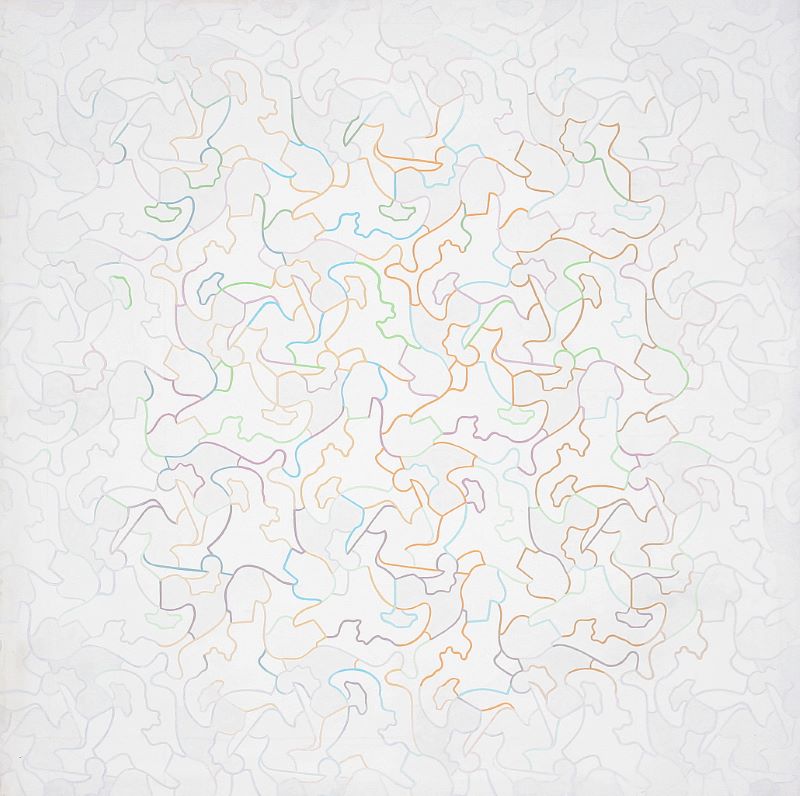
L to R: George Woodman. “285” or “Bari” or “Winterreise”, 1975, 65 x 65 in. Acrylic on canvas | Francesca Woodman. “Untitled”, c. 1975-78, 6 5/8 x 6 9/16 in. Gelatin silver print | Betty Woodman. “Joined Vases”, 1972, 11 1/2 x 23 x 10 in. Porcelain | Francesca Woodman. “Untitled”, c. 1979-80, 11 x 14 in. Gelatin silver print | George Woodman. “Study in White: Marble from Michelangelo’s Quarry”, 2004, 16 x 20 in. Gelatin silver print | Betty Woodman. “Boys”, 2013, 28 x 28 x 7 in. Glazed earthenware | George Woodman. “Untitled”, 1974, 84 x 84 in. Acrylic on canvas | Detail from Betty Woodman. “Aeolian Pyramid”, 2001/2006, approx. 150 x 168 x 100 in. Glazed earthenware, epoxy resin, lacquer, paint | George Woodman. “Tessellation Sky”, 1975, 54 1/2 x 54 1/2 in. Acrylic on canvas | Betty Woodman. “Nina’s Room”, 2012, 86 x 107 x 12 1/2 in. Glazed earthenware, epoxy resin, lacquer, acrylic paint, canvas | Francesca Woodman. “Untitled”, c. 1977-78, 3 13/16 x 3 7/8 in. Gelatin silver print | Betty Woodman. “Judith’s Window”, 2012, 59 1/2 x 43 1/2 x 10 1/2 in. Glazed earthenware, epoxy resin, lacquer, acrylic paint, canvas, wood | Francesca Woodman. “Untitled”, 1980, 8 1/2 x 8 1/2 in. Gelatin silver print | Betty Woodman. “Divided Vases: Window”, 2012, 33 1/4 x 42 x 7 1/2 in. Glazed earthenware, epoxy resin, lacquer, paint | Francesca Woodman. “Untitled”, 1976, 5 1/8 x 5 1/8 in. Gelatin silver print | George Woodman. “Untitled”, c. 1980, dimensions unknown. Acrylic on canvas | Francesca Woodman. “Untitled”, c. 1979-80, 3 7/8 x 5 5/8 in. Gelatin silver print | Francesca Woodman. “Untitled,” c. 1979-80, 5 1/2 x 5 5/8 in. Gelatin silver print | George Woodman. “Christening Dress and Roman Sculpture (A Roman Fragment with a Christening Dress)”, 2011, 42 x 38 1/2 in. Oil on gelatin silver print | Betty Woodman. “White Amphoras”, 2004, 33 x 57 x 12 in. Glazed earthenware. All artworks © Woodman Family Foundation / Artists Rights Society (ARS), New York
George Woodman. “285” or “Bari” or “Winterreise”, 1975, 65 x 65 in. Acrylic on canvas © Woodman Family Foundation / Artists Rights Society (ARS), New York
The Woodmans and the use of white
Betty Woodman and George Woodman are often celebrated for their exuberant use of color, while Francesca Woodman is best known for her dramatic black-and-white photographs, filled with shades of grey. Working across different mediums and methods, the Woodman artists used white—and the absence of color—to fascinating effects.

L to R: "Hymn to Classicism," 1993, 20 x 24 in. Gelatin silver print - "Psyche and Amor," 1993, 20 x 16 in. Gelatin silver print | "Psyche and Amor in the Wisteria," 1988, 20 x 16 in. Gelatin silver print | "Psyche, Amor and Iris," 1988, 20 x 16 in. Gelatin silver print | "Psyche, Amor and Sara," 2010, 16 5/16 x 22 5/8 in. Oil on gelatin silver print | "Canova Museum," 2010, 42 x 36 in. Oil on gelatin silver print. All artworks by George Woodman © Woodman Family Foundation / Artists Rights Society (ARS), New York
George Woodman. "Hymn to Classicism," 1993, 20 x 24 in. Gelatin silver print © Woodman Family Foundation / Artists Rights Society (ARS), New York
Cupid and Psyche's divine love in George Woodman's photographs
Neoclassical beauty, particularly as depicted through sculptures of embracing lovers, is a recurring theme in George Woodman’s photographs—especially the myth of Psyche and Cupid’s divine love.

L to R: 1-3, 5, 6: Installation views, “An Interior Exchanged,” Fashion Institute of Technology, New York, New York, 1982. Woodman Family Foundation Archives | 4: Spread from “Wallpapers for Historic Buildings” by Richard C. Nylander, The Preservation Press, Washington, D.C., 1983 | 7: Betty Woodman, “Cloistered Arbor Room,” 1981, 10 x 23 ft. Glazed earthenware, epoxy resin, lacquer, fabric. Installation view from “The Elizabeth Reed Keller Memorial Exhibition: Ceramics,” Suzanne Lemberg Usdan Gallery, Bennington College, Bennington, Vermont, 1981 | 8: Betty Woodman, “Bedroom with Lattice,” 2009, 92 x 85 x 15 in. Glazed earthenware, paint, canvas | 9: Spread from “Pompei ercolano stabile oplontis: le città sepolte dal Vesuvio” by Pietro Giovanni Guzzo, Electa Napoli, Italy, 2003 | 10: Betty Woodman, “Villa Oplontis,” 2006, 45 x 121 x 11 in. Terra sigillata, canvas, glazed earthenware, epoxy resin, lacquer, wood | 11: Betty Woodman, “Il Giardino Dipinto,” 1993, 9 x 35 ft. Glazed earthenware, epoxy resin, lacquer, paint. Installation view from “Betty Woodman: Il Giardino Dipinto,” Rhode Island School of Design Museum, Providence, Rhode Island, 2005 | 12: Selected books on wall paintings, wallpapers, and architecture from Betty Woodman’s collection | 13: Betty Woodman, “Wallpaper: 11,” 2016, 120 x 144 in. Glazed earthenware, epoxy resin, lacquer, acrylic paint. All Betty Woodman artworks © Woodman Family Foundation / Artists Rights Society (ARS), New York
Installation view, “An Interior Exchanged,” Fashion Institute of Technology, New York, New York, 1982. Woodman Family Foundation Archives
Betty Woodman's collaboration with Cynthia Carlson and her pivot to the wall
In the spring of 1981, Betty Woodman and Cynthia Carlson started planning for “An Interior Exchanged,” an environmental collaboration presented in ARTISANSPACE at the Fashion Institute of Technology in 1982.
.png)

L to R: Micaela shows the Pratt class a magazine article on George Woodman and Betty Woodman. Photo by Cristina Pattuelli. | Detail of a drawing done by Francesca Woodman with a note to Betty Woodman and George Woodman. The drawing includes a sofa Francesca used as a prop in photographs and teacups likely depict Betty Woodman’s ceramics. Flight information in the note may help us establish timelines for all three artists in the future. | Photo boxes owned by George Woodman. While the boxes are not “archival” (acid free), the information written on them by the artist makes them valuable in establishing provenance of final artworks. | The archive interior. Simple industrial rolling racks are utilized to hold archival assets.
Micaela shows the Pratt class a magazine article on George Woodman and Betty Woodman. Photo by Cristina Pattuelli.
Visit to WFF Archive from the Pratt School of Information’s MSLIS program, November 18, 2024
The Woodman Family Foundation archive was delighted to host students from the Art Documentation class in the Pratt School of Information’s MSLIS program on November 18. Professor Cristina Pattuelli, consulting archivist Sewon Kang, and the students joined us to survey of some of the archives highlights and have an engaging discussion on the unique opportunities and challenges the Woodman Family archives have.
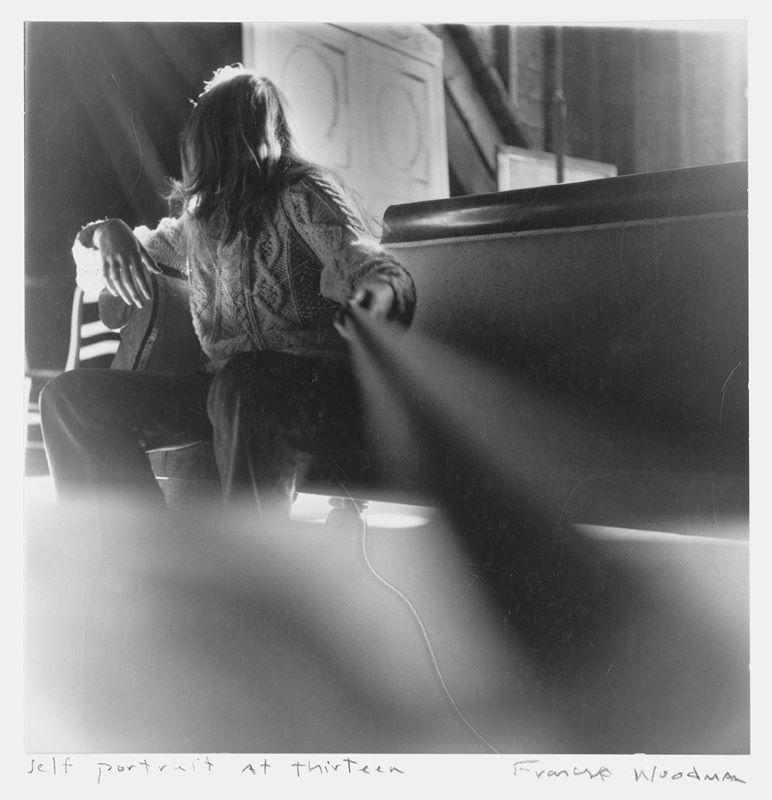
L to R: “Self-Portrait at Thirteen," c. 1972, 6 3/4 x 6 11/16 in. Gelatin silver print | 2 & 3: Francesca Woodman's Yashica Mat-124G camera | “Untitled," 1979, 3 5/16 x 3 1/2 in. Chromogenic print. All artworks by Francesca Woodman © Woodman Family Foundation / Artists Rights Society (ARS), New York. Woodman Family Foundation Archives.
Francesca Woodman, “Self-Portrait at Thirteen," c. 1972, 6 3/4 x 6 11/16 in. Gelatin silver print © Woodman Family Foundation / Artists Rights Society (ARS), New York.
Francesca Woodman's first camera
In 1972, Francesca Woodman received her first camera, a 6x6 twin-lens reflex Yashica Mat-124G, from her father, George Woodman.

Image details: 1. Betty Woodman at work in her studio in Antella, Italy, 1996. Photograph by George Woodman | 2. An assemblage of Betty Woodman’s studio materials. Clockwise from bottom left: Rocket Expansion cement, broken ceramic pieces, measuring cup, sponges, Orton standard pyrometric cones (open box) Orton small pyrometric cones, fork, toothbrush, kitchen knife | 3. George Woodman in his New York City studio c. 1980s | 4. An assemblage of George Woodman’s studio materials. Clockwise from bottom left: Gorton vapor equalizing valve, Bessey vise clamp, Xcemite screw driver, rubber hook tool, Dap silicone, GE silicone, Stanley level, Conair hair dryer, Wiss pliers, Great Neck wood chisel, Maimeri set of paints
Betty Woodman at work in her studio in Antella, Italy, 1996. Photograph by George Woodman. Woodman Family Foundation Archives.
Tools used by Betty Woodman and George Woodman
October is American Archives Month and we are celebrating by looking at some of the tools of the trade used by George Woodman and Betty Woodman in our collection.

L to R: Betty, Charles, and Francesca Woodman in front of the New York World's Fair Unisphere, 1964 / Charles and Francesca Woodman in front of Thailand's pavilion, 1964 / Bird's eye view of the New York World's Fair, 1964. Woodman Family Foundation Archives.
Betty, Charles, and Francesca Woodman in front of the New York World's Fair Unisphere, 1964. Woodman Family Foundation Archives.
The Woodmans at the 1964 New York World's Fair
Sixty years ago, before they had traveled much of the world together, the Woodman family visited the 1964-1965 New York World’s Fair in Flushing Meadows-Corona Park.

Detail: Betty Woodman walking under torii gates, Japan, 1990 / Pair: Details of Betty Woodman and George Woodman in a traditional ryokan inn, Japan, 1990 / Betty Woodman, Japan, 1990 / George Woodman, Japan, 1990 / George Woodman, Shinto shrine, Japan, 1990 / Hōryū-ji Temple, Nara, Japan, 1990 / Buddhist Guardian statue, Hōryū-ji Temple, Nara, Japan, 1990 / Pillars, Hōryū-ji Temple, Nara, Japan, 1990 / Shave ice stall, Japan, 1990. Woodman Family Foundation Archives.
Detail: Betty Woodman walking under torii gates, Japan, 1990. Woodman Family Foundation Archives.
Betty Woodman and George Woodman in Japan, 1990
As the solstice today marks the official beginning of summer, we are reminded of the Woodmans’ extensive travels around the world and their months immersed in global artistic influences.

L to R: Images 1-4: Betty Woodman’s brushes / Detail of "Roman Girls," 2008, 35 x 70 x 11 in. Glazed earthenware, epoxy resin, lacquer, paint / Detail of "History of the Amphora," 2011, 6 ft. x 8 ft. x 1 in. Glazed earthenware, epoxy resin, lacquer, acrylic paint / Detail of “Country House,” 2005, 66 x 32 x 9 1/2 in. Glazed earthenware, epoxy resin, lacquer / Woodman’s glazes / Detail of "Spring Wall Relief," 2009, 60 x 48 x 1 in. Glazed earthenware / Detail of "His and Hers Vases: Ferris Wheel," 2006, 28.5 x 73 x 14.5 in. Glazed earthenware, epoxy resin, lacquer, and paint / All works by Betty Woodman. © Woodman Family Foundation / Artists Rights Society (ARS), New York. Woodman Family Foundation Archives.
Betty Woodman’s brushes. Woodman Family Foundation Archives.
Betty Woodman's glazes, paints, and brushes
Betty Woodman’s numerous glazes, paints, and the varied configurations of brushes—sometimes mixed or assembled by the artist herself to achieve desired color swatches, brushy marks, and parallel stripes—reflect her continuously innovative work with ceramic forms.

L to R: Betty Woodman, Francesca Woodman and Nancy Graves in Italy, 1966 / Charlie Woodman and Richard Serra in Italy, 1966 / Betty Woodman with Nancy Graves, Richard Serra and unknown friend in Italy, 1965. Woodman Family Foundation Archives.
Betty Woodman, Francesca Woodman and Nancy Graves in Italy, 1966. Woodman Family Foundation Archives.
The Woodmans, Nancy Graves and Richard Serra in Italy
Over the course of a year from 1965-66, the Woodman family lived and worked in Italy, just outside of Florence. During that time, Betty and George became close friends with the artists and then-couple Nancy Graves and Richard Serra, who, like Betty, was there for the year on a Fulbright-Hays scholarship. They spent many hours together around the table, sharing meals, funny hats and conversations about art.