

News
Announcements From the Foundation
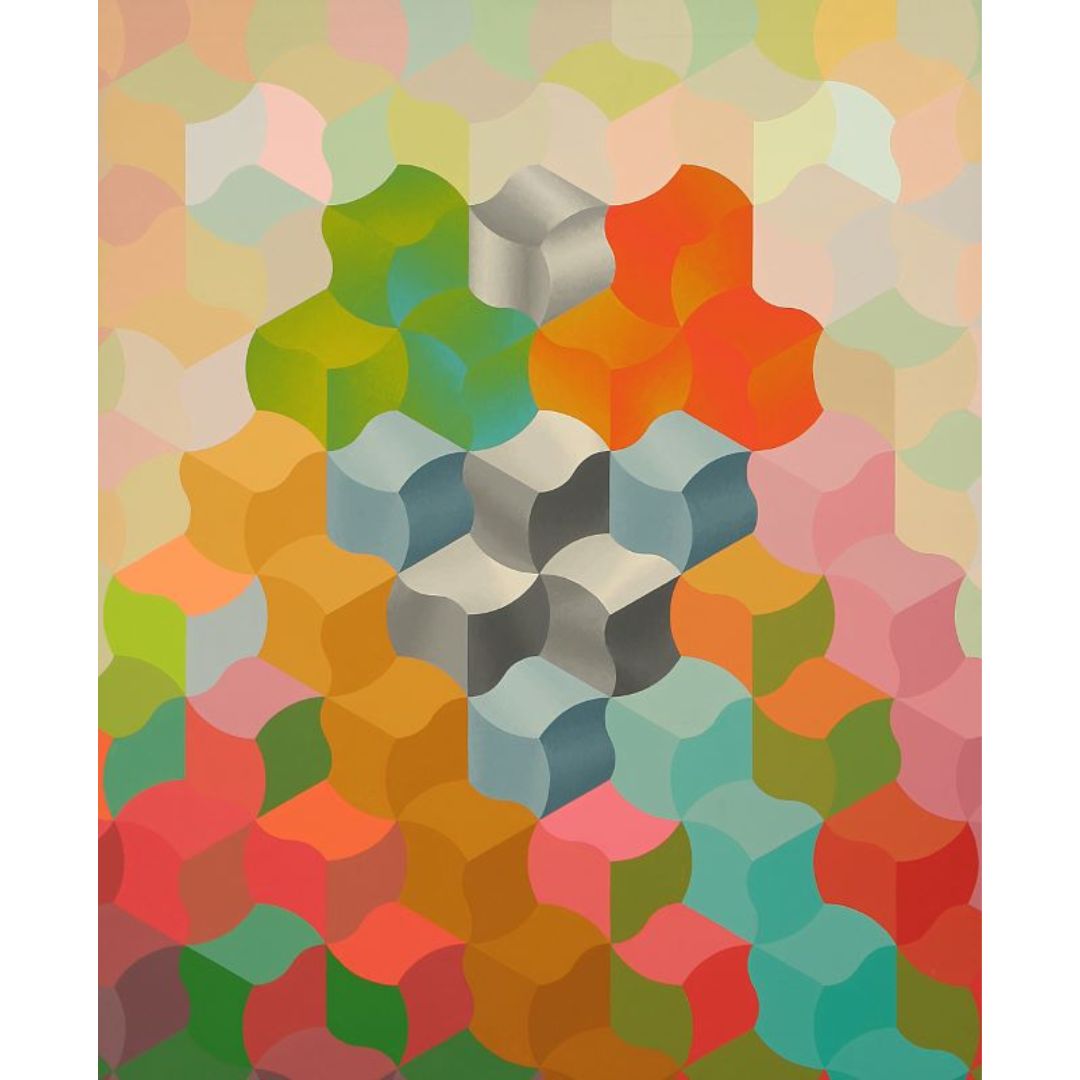
1: “Magic Mountain,” c. 1970, 66 x 54 in. Oil on canvas | 2: “Untitled,” 1969, 48 1/4 x 48 1/4 in. Acrylic on canvas | 3: “Cascade,” 1974, 36 x 36 in. Acrylic on canvas | 4: “Untitled,” 1974, 66 x 66 in. Acrylic and oil on canvas | 5: “Cloud,” 1969, 68 3/4 x 58 1/2 in. Oil on canvas | 6: “Untitled,” 1970, 54 1/4 x 54 1/4 in. Acrylic on canvas | 7: “Untitled,” c. 1974-76, 59 x 59 in. Acrylic on canvas | 8: “Color Octagon,” 1975, 83 x 83 in. Acrylic on canvas | 9: “Winterreise,” 1975, 85 x 85 in. Acrylic on canvas. All artworks by George Woodman © Woodman Family Foundation / Artists Rights Society (ARS), New York.
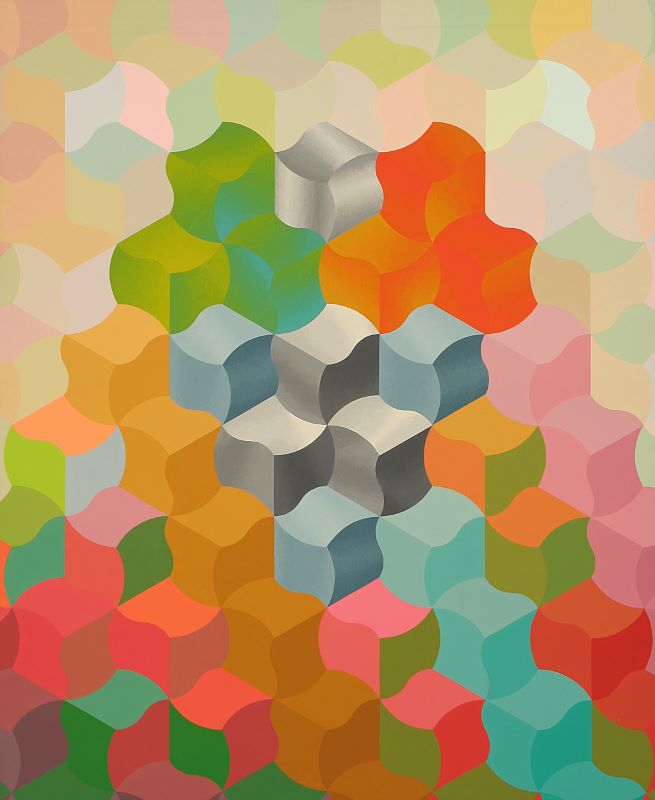
George Woodman. “Magic Mountain,” c. 1970, 66 x 54 in. Oil on canvas © Woodman Family Foundation / Artists Rights Society (ARS), New York
Idiosyncratic use of color. "George Woodman: A Democracy of Parts, Paintings 1966-1978," DC Moore Gallery, New York, 2025
Pattern paintings made up of repeating forms can tend towards uniformity or sameness, but not so for George Woodman. Instead, he integrated color into his pattern systems as an equal to form rather than a subordinate, constructing compositions in which color steers and complicates the viewer’s perception.
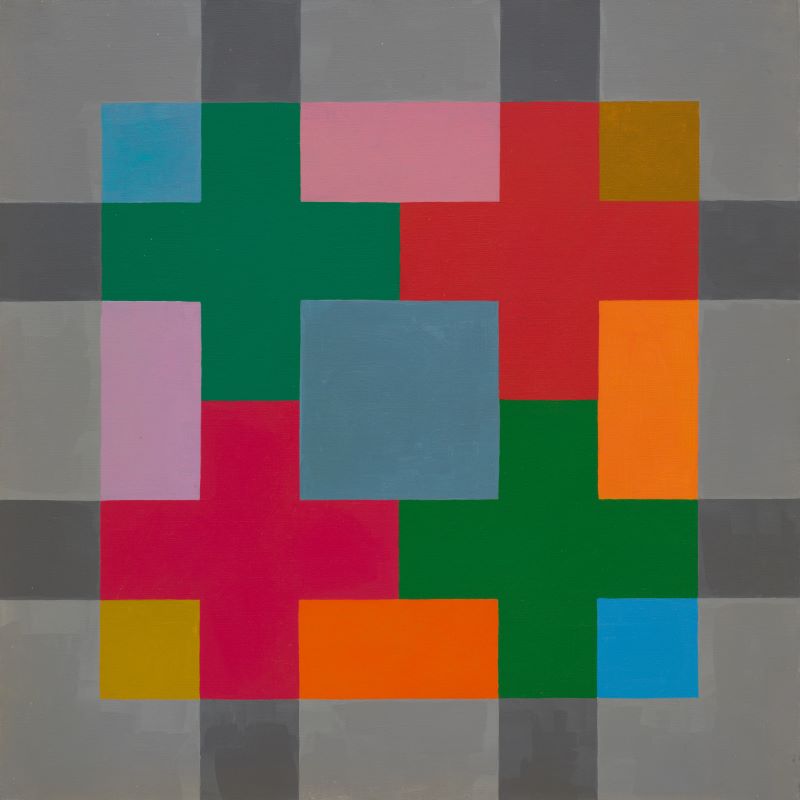
L to R: 1: George Woodman, “Piazza San Francesco di Paola,” 1966, 32 x 32 in. Oil on canvas | 2: George Woodman, “Untitled,” 1964, 49 x 49 in. Oil on canvas | 3: George Woodman, “Untitled,” c. 1965, 57 x 68 in. Acrylic on canvas | 4: George Woodman, “Untitled,” 1967, 65 x 65 in. Oil on canvas | 5: George Woodman, “Rainbow Funnel,” c. 1967-69, 63 x 39 1/2 in. Acrylic on canvas | 6: George Woodman, Notes from a lecture on Sol LeWitt, c. 1976. Woodman Family Foundation Archives. | 7: George Woodman, Notes from a lecture on Pattern and Art, c. 1979. Woodman Family Foundation Archives. | 8: Sol LeWitt, “Wall Drawing 1: Drawing Series II 18 (A & B),” 1968, each 48 x 48 in. Graphite on wall. San Francisco Museum of Modern Art © The LeWitt Estate | 9: Sol LeWitt, “Cubic-Modular Wall Structure, Black,” 1966, 43 1/2 x 43 1/2 x 9 3/8 in. Painted wood. Museum of Modern Art © The LeWitt Estate | 10: Sol LeWitt, “Serial Project, I (ABCD),” 1966, 20 in. x 13 ft. 7 in. x 13 ft. 7 in. Baked enamel on steel units over baked enamel on aluminum. Museum of Modern Art © The LeWitt Estate | 11: Frank Stella, “Harran II,” 1967, 10 x 20 ft. Polymer on fluorescent polymer paint on canvas. Solomon R. Guggenheim Museum © Estate of Frank Stella | 12: Frank Stella, “Gray Scramble,” 1968-69, 69 x 69 in. Oil on canvas. Solomon R. Guggenheim Museum © Estate of Frank Stella | 13: Alfred Jensen, In-text plate (folio 13) from “A Pythagorean Notebook,” 1965, 15 9/16 × 20 11/16 in. Composition from illustrated book with 20 lithographs, published by Tamarind Lithography Workshop. Museum of Modern Art © Estate of Alfred Jensen | 14: Alfred Jensen, “That Is It,” 1966, 42 x 36 in. Oil on canvas. Museum of Modern Art © Estate of Alfred Jensen | 15: Alfred Jensen, “The Acrobatic Rectangle Per, Eleven,” 1967, 68 x 48 1/2 in. Oil on canvas. Whitney Museum of American Art © Estate of Alfred Jensen | 16: Agnes Martin, “Orchards of Lightning,” 1966, 11 3/4 x 9 3/8 in. Ink on paper. Museum of Modern Art © Estate of Agnes Martin | 17: Agnes Martin, “Untitled,” 1963, 8 x 8 in. Brush and ink and pen and ink on paper. Whitney Museum of American Art © Estate of Agnes Martin | 18: Agnes Martin, “Untitled,” 1960, 70 x 70 in. Oil on canvas. Dia Art Foundation © Estate of Agnes Martin. All George Woodman artworks © Woodman Family Foundation. All artworks © Artists Rights Society (ARS), New York
George Woodman, “Piazza San Francesco di Paola,” 1966, 32 x 32 in. Oil on canvas © Woodman Family Foundation / Artists Rights Society (ARS), New York
George Woodman in dialogue with New York minimalist painters. “George Woodman: A Democracy of Parts, Paintings 1966-1978,” DC Moore Gallery, New York, 2025
In her essay for the exhibition’s catalogue—“The Mind as it Measures: George Woodman’s Patterns”—curator Rebecca Skafsgaard Lowery discusses Woodman’s approach to pattern and color in the context of his contemporaries.
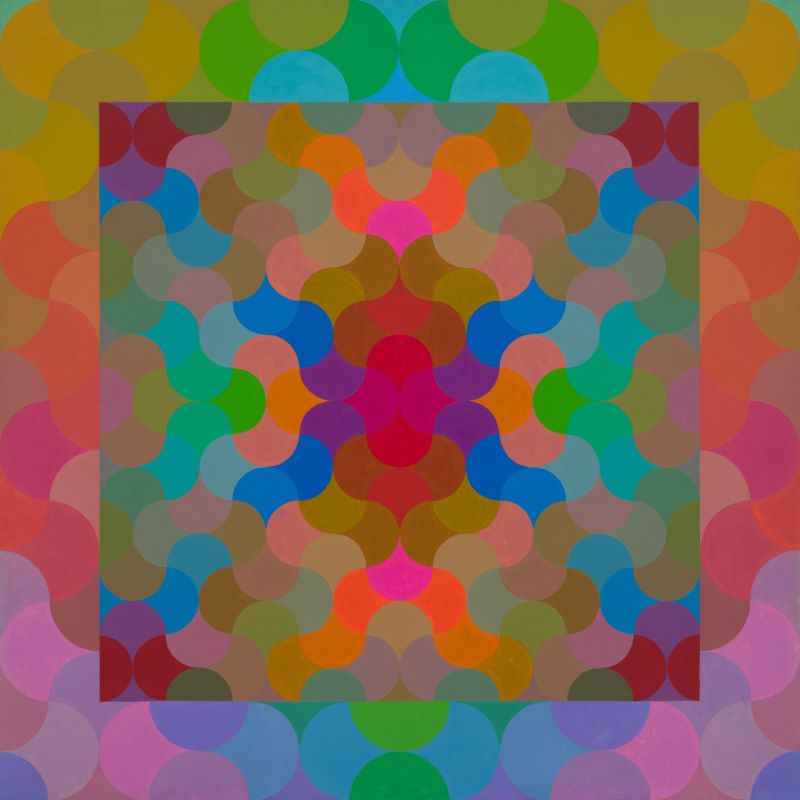
L to R: 1: “Untitled,” c. 1970-71, 66 3/8 x 66 3/8 in. | 2: “Untitled,” c. 1971, 52 x 52 in. | 3: “7 Colors in 4’s,” 1966, 67 x 67 in. | 4: “Untitled,” 1968, 63 x 98 1/4 in. | 5: “Untitled,” 1975, 60 x 60 in. | 6: “Untitled,” 1978, 49 x 49 in. All acrylic on canvas. All artworks by George Woodman © Woodman Family Foundation / Artists Rights Society (ARS), New York
George Woodman. “Untitled,” c. 1970-71, 66 3/8 x 66 3/8 in. Acrylic on canvas © Woodman Family Foundation / Artists Rights Society (ARS), New York
ON VIEW: "George Woodman: A Democracy of Parts, Paintings 1966-1978," DC Moore Gallery, New York, 2025
Focusing on geometric abstractions from a significant period within the artist's six-decade career, this exhibition traces the development of George Woodman's singular approach to pattern.

L to R: 1: Betty Woodman, “Ceramic Pictures of Korean Paintings: Rose Lattice Tree Vase, Tiger Lily Tree Vase, Evergreen Tree Vase, Lotus Tree Vase, Camellia Tree Vase,” 2001/2002, 37.5 x 10 x 1 ft. Glazed earthenware, clay, canvas | 2: Installation view, “Betty Woodman,” Daum Museum of Contemporary Art, Sedalia, Missouri, 2002 | 3, Pair: Detail from Betty Woodman, “Cactus, Lotus, and Butterfly,” 2005 / Page from “Korean Art Book Vol. 6: Minhwa I” by Yoon Yeol-soo, Yekyung Publishing, Korea, 2000 | 4: Betty Woodman, “Cactus, Lotus, and Butterfly,” 2005, 120 x 90 x 12 in. Glazed earthenware, canvas | 5, Pair: Page from “Korean Art Book Vol. 6: Minhwa I” / Detail from Betty Woodman, “Cartoon of Roman Paintings: Santa Brigida,” 2005 | 6: Betty Woodman, “Cartoon of Roman Paintings: Santa Brigida,” 2005, 98 x 86 in. Terra sigillata, ink and wax on paper | 7, Pair: Detail from Betty Woodman, “Cartoon of Roman Paintings: Santa Brigida,” 2005 / Page from “Korean Art Book Vol 7: Minhwa II” by Yoon Yeol-soo, Yekyung Publishing, Korea, 2000 | 8: Spread from “Korean Art Book Vol 6: Minhwa I” with handwritten note by Betty Woodman | 9: Betty Woodman, “Siena: Ceramic Pictures of Korean Vases,” 2004, 96 x 84 x 9 1/2 in. Glazed earthenware, clay, canvas | 10: “Korean Art Book” volumes 1, 2, 6, 7, from Betty Woodman’s collection. All Betty Woodman artworks © Woodman Family Foundation / Artists Rights Society (ARS), New York
Betty Woodman, “Ceramic Pictures of Korean Paintings: Rose Lattice Tree Vase, Tiger Lily Tree Vase, Evergreen Tree Vase, Lotus Tree Vase, Camellia Tree Vase,” 2001/2002, 37.5 x 10 x 1 ft. Glazed earthenware, clay, canvas © Woodman Family Foundation / Artists Rights Society (ARS), New York
Betty Woodman and works inspired by Korean folk painting
On a trip to South Korea in 2001, Betty Woodman was introduced to the Joseon Dynasty folk art (minhwa)—with motifs like vibrant scenes of peonies and lotuses. With these paintings in mind, she started a new series of wall-based works titled “Ceramic Pictures of Korean Paintings,” which she first showed at the Daum Museum in 2002 as a five-panel mural.

Photos, L to R: Betty Woodman in her New York studio, c. 1983 | Francesca Woodman, c. 1979-80. Photo: George Woodman | George Woodman in front of his paper tile installation, 1979 Woodman Family Foundation Archives. Artwork and photo by George Woodman © Woodman Family Foundation / Artists Rights Society (ARS), New York
Graphic with text: "WFF Housing Stability Grant for Artists / 3-year rent subsidies for 5 visual artists in NYC"
Announcing the WFF Housing Stability Grant for NYC-based visual artists
In recognition of the increasing unaffordability of rental housing in New York City and the housing insecurity it creates for artists, WFF will award grants of $30,000—distributed over three years—to five visual artists with the goal of improving their housing stability.

L to R: Group, T to B: Betty Woodman, “Athens,” 1991, 35 1/2 x 68 5/8 x 10 1/4 in. Glazed earthenware, epoxy resin, lacquer, and paint / George Woodman, “Untitled,” c. 1966-68, 39 1/2 x 39 1/2 in. Acrylic on canvas / Francesca Woodman, “After My Grandmother's Funeral,” 1977, from the “After My Grandmother's Funeral” series, 5 1/8 x 5 1/4 in. Gelatin silver print | Betty Woodman, “Athens,” 1991, 35 1/2 x 68 5/8 x 10 1/4 in. Glazed earthenware, epoxy resin, lacquer, and paint | George Woodman, “Untitled,” c. 1966-68, 39 1/2 x 39 1/2 in. Acrylic on canvas | Francesca Woodman, “After My Grandmother's Funeral” series, 1977. Gelatin silver prints | Francesca Woodman, “After My Grandmother's Funeral,” 1977, from the “After My Grandmother's Funeral” series, 5 1/8 x 5 1/4 in. Gelatin silver print | Francesca Woodman, “After My Grandmother's Funeral,” 1977, from the “After My Grandmother's Funeral” series, 5 1/8 x 5 1/8 in. Gelatin silver print | Francesca Woodman, “Untitled,” 1977, from the “After My Grandmother's Funeral” series, 5 5/16 x 5 1/4 in. Gelatin silver print | Francesca Woodman, “After My Grandmother's Funeral,” 1977, from the “After My Grandmother's Funeral” series, 5 x 5 1/8 in. Gelatin silver print | Francesca Woodman, “After My Grandmother's Funeral,” 1977, from the “After My Grandmother's Funeral” series, 5 1/8 x 5 1/8 in. Gelatin silver print | Francesca Woodman, “2,” 1977, from the “After My Grandmother's Funeral” series, 5 1/4 x 5 1/4 in. Gelatin silver print All artworks © Woodman Family Foundation / Artists Rights Society (ARS), New York.
Group, T to B: Betty Woodman, “Athens,” 1991 / George Woodman, “Untitled,” c. 1966-68 / Francesca Woodman, “After My Grandmother's Funeral,” 1977, from the “After My Grandmother's Funeral” series © Woodman Family Foundation / Artists Rights Society (ARS), New York.
Acquisition by the Currier Museum of Art, Manchester, New Hampshire, 2024
We are very pleased to announce the acquisition of a group of important works by Betty Woodman, Francesca Woodman, and George Woodman from the Foundation’s holdings by the Currier Museum of Art in Manchester, New Hampshire.

L to R: 1: Betty Woodman, “Wallpaper,” 2013, 84 x 120 in. Glazed earthenware, epoxy resin, lacquer, acrylic paint | 2, 9: Page from “The Cut-Outs of Henri Matisse” | 3: Betty Woodman, “Orange Rug with Clay Bones,” 2013, 105 1/4 x 47 x 1 in. Earthenware, canvas, acrylic paint | 4: Detail from Henri Matisse, “Oceania, the Sea,” 1948, 68 1/8 × 152 1/2 in. Linen, plain weave; screen printed. Produced by Zika Ascher, Ltd. Art Institute of Chicago. | 5: Detail from “Orange Rug with Clay Bones,” 2013 | 6: Betty Woodman, “Balustrade Relief Vase 05-1,” 2005, 55 x 48 x 9 in. Glazed earthenware, epoxy resin, lacquer | 7: Betty Woodman, "Outside and In," 2017, 75 1/2 x 120 x 10 1/2 in. Glazed earthenware, epoxy resin, lacquer, acrylic paint, canvas, wood | 8: Betty Woodman, “House of the South,” 1994-1996, 159 x 246 x 9 1/2 in. Glazed earthenware, epoxy resin, lacquer, paint. Installation view from “The Art of Betty Woodman,” Metropolitan Museum of Art, New York, New York, 2006 | 10: "The Cut-Outs of Henri Matisse” by John Elderfield, New York: George Braziller, 1978, from Betty Woodman’s collection. All Betty Woodman artworks © Woodman Family Foundation / Artists Rights Society (ARS), New York. All Henri Matisse artworks © Succession H. Matisse / Artists Rights Society (ARS), New York
Betty Woodman, “Wallpaper,” 2013, 84 x 120 in. Glazed earthenware, epoxy resin, lacquer, acrylic paint © Woodman Family Foundation / Artists Rights Society (ARS), New York
Betty Woodman's works and Matisse's cut outs
Betty Woodman's eclecticism reflects a wide array of influences, including those from modernist French painters like Gauguin, Bonnard, and Matisse. Yet Woodman’s connection to Matisse transcends their shared use of vivid, exuberant colors. Both artists indulged in decorative impulses through their inventive use of positive and negative space.

L to R: Francesca Woodman, “Untitled," c. 1976, 4 7/8 x 5 1/8 in. Courtesy Elton John and David Furnish Collection. | Exhibition poster, “Fragile Beauty: Photographs from the Sir Elton John and David Furnish Collection” with Harley Weir, “Boys Don’t Cry, Senegal, 2015,” 2015 © Harley Weir | Francesca Woodman, “Untitled,” 1979, 5 7/8 x 5 13/16 in. | Detail from installation view of “Fragile Beauty: Photographs from the Sir Elton John and David Furnish Collection," Victoria and Albert Museum, 2024. Image courtesy and copyright Victoria and Albert Museum & James Retief | Exhibition graphic, “The ‘70s Lens: Reimagining Documentary Photography” with Anthony Barboza, “New York City,” 1970s © Anthony Barboza Photography | Francesca Woodman, “Untitled,” c. 1977-78, 5 9/16 x 5 3/8 in. | Francesca Woodman, “House #3,” c. 1975-76, from the “Abandoned House” series, 6 3/8 x 6 7/16 in. All Francesca Woodman works gelatin silver prints © Woodman Family Foundation / Artists Rights Society (ARS), New York / DACS, London
Francesca Woodman, “Untitled," c. 1976, 4 7/8 x 5 1/8 in. Gelatin silver print. Courtesy Elton John and David Furnish Collection. © Woodman Family Foundation / DACS, London
ON VIEW: Francesca Woodman in “Fragile Beauty: Photographs from the Sir Elton John and David Furnish Collection” and “The ‘70s Lens: Reimagining Documentary Photography,” 2024
This fall, check out two group exhibitions showcasing works by Francesca Woodman. Known for her performative approach to photography, Woodman stages the female body and intervenes in the environment to create narratives rich in metaphor.
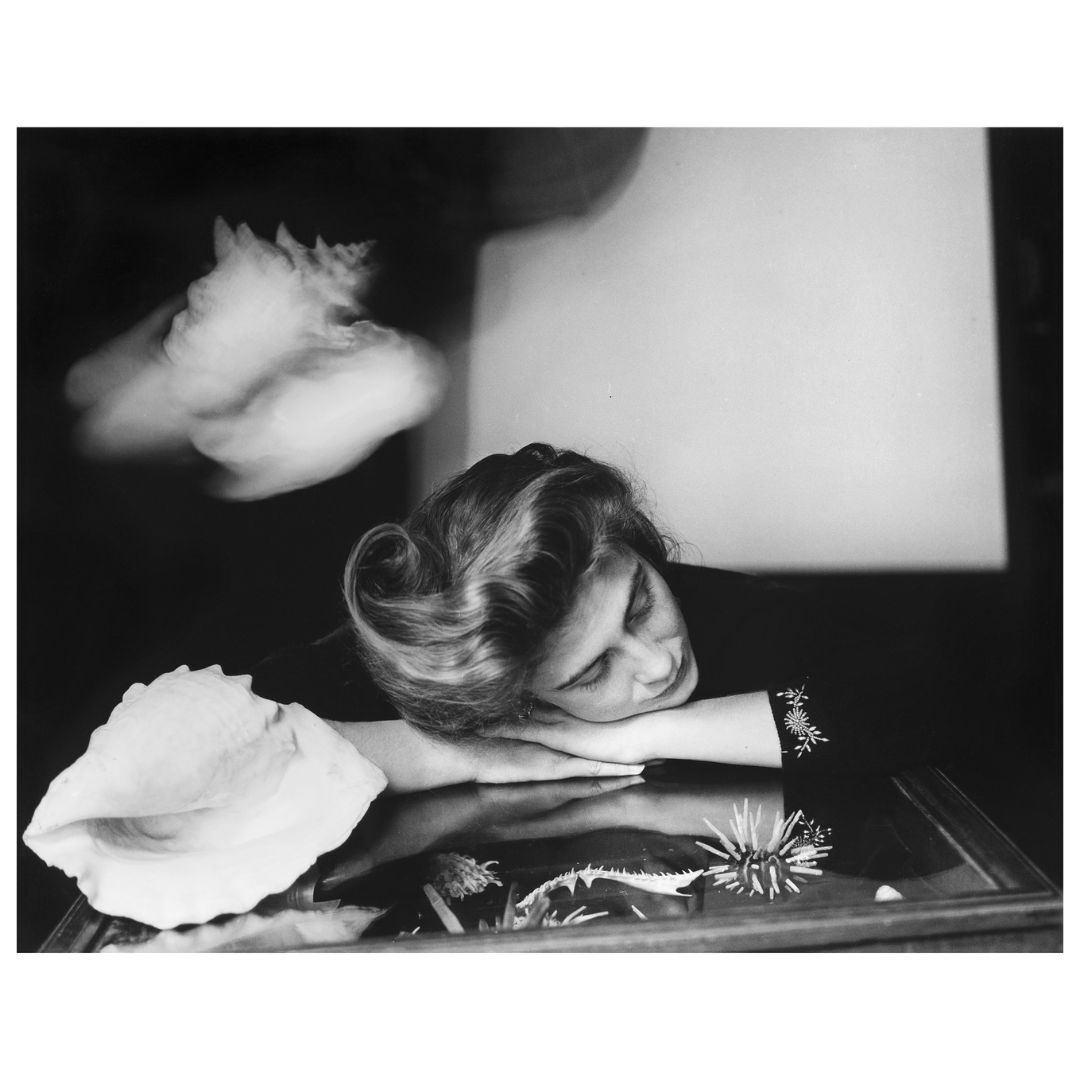

Francesca Woodman. "Untitled," c. 1975-78, 9 1/2 x 12 1/4 in. (24.13 x 31.12 cm). Gelatin silver print © Woodman Family Foundation / VISDA, Copenhagen.
ON VIEW: "OCEAN," Louisiana Museum of Modern Art, Humlebæk, Denmark, 2024
This exhibition delves into the depths where imagination meets reality, considering ways the sea has been a source of adventure and destruction throughout history.

L to R: 1: Betty Woodman. “Edo Fashion Ladies,” 2006, glazed earthenware, 34 1/2 x 32 1/2 x 7 in. | 2: Page from “Fashion of Edo: Women's Dress in Ukiyo-e Paintings 1989." Japan Institute of Arts and Crafts, 1989 | 3 & 7: Betty Woodman. “After the Bath,” 2011, glazed earthenware, epoxy resin, lacquer, acrylic paint, 35 x 37 1/2 x 8 in. | 4: Pair: Detail from Betty Woodman, “After the Bath” / Ippitsusai Bunchō, “Kagiya Osen,” from “Japanese Prints” by Gabriele Fahr-Becker, Barnes & Noble Inc., 2003 | 5: Detail from Betty Woodman, “After the Bath” | 6: Ishikawa Toyonobu, “After the Bath,” page from “Japanese Prints” by Gabriele Fahr-Becker | 8: Spread from “Edo Chiyogami” by Hirose Tatsugoro, Seigensha, 2002 | 9: “Fashion of Edo: Women's Dress in Ukiyo-e Paintings 1989." Japan Institute of Arts and Crafts, 1989, with torn page | 10: Selected publications on Japanese art from Betty Woodman’s collection All Betty Woodman artworks © Woodman Family Foundation / Artists Rights Society (ARS), New York.
Betty Woodman. “Edo Fashion Ladies,” 2006, glazed earthenware, 34 1/2 x 32 1/2 x 7 in. © Woodman Family Foundation / Artists Rights Society (ARS), New York
Betty Woodman’s books on Japanese textiles and woodblock prints
Over the past few months, the Foundation delved into Betty Woodman's and George Woodman’s personal library as part of our ongoing work to build a study center. Betty Woodman’s books on Japanese textiles and woodblock prints, in particular, are extensively bookmarked, with pages cut and ripped away by the artist. She often amassed many of these books on her travels regardless of whether she could read the language, choosing instead to let the images weave themselves into her visual lexicon.

L to R: Pair: “Athens,” 1991 / “Massenet,” ed. 8/8, 2010 | “Athens,” 1991, Glazed earthenware, epoxy resin, lacquer, and paint. 35 1/2 x 68 5/8 x 10 1/4 in. | “Massenet,” ed. 8/8, 2010, Soft-paste porcelain biscuit. © Sèvres - Manufacture et musée nationaux, 2013.D.8587.1 / 20013.D.8587.2. Photographer: Gerard Jonca. All works by Betty Woodman © Woodman Family Foundation / Artists Rights Society (ARS), New York
Pair: “Athens,” 1991 / “Massenet,” ed. 8/8, 2010. Works by Betty Woodman © Woodman Family Foundation / Artists Rights Society (ARS), New York
ON VIEW: New Betty Woodman exhibitions, September 2024
This month, explore two group exhibitions in New York showcasing diverse works by Betty Woodman from the 1990s and 2000s.
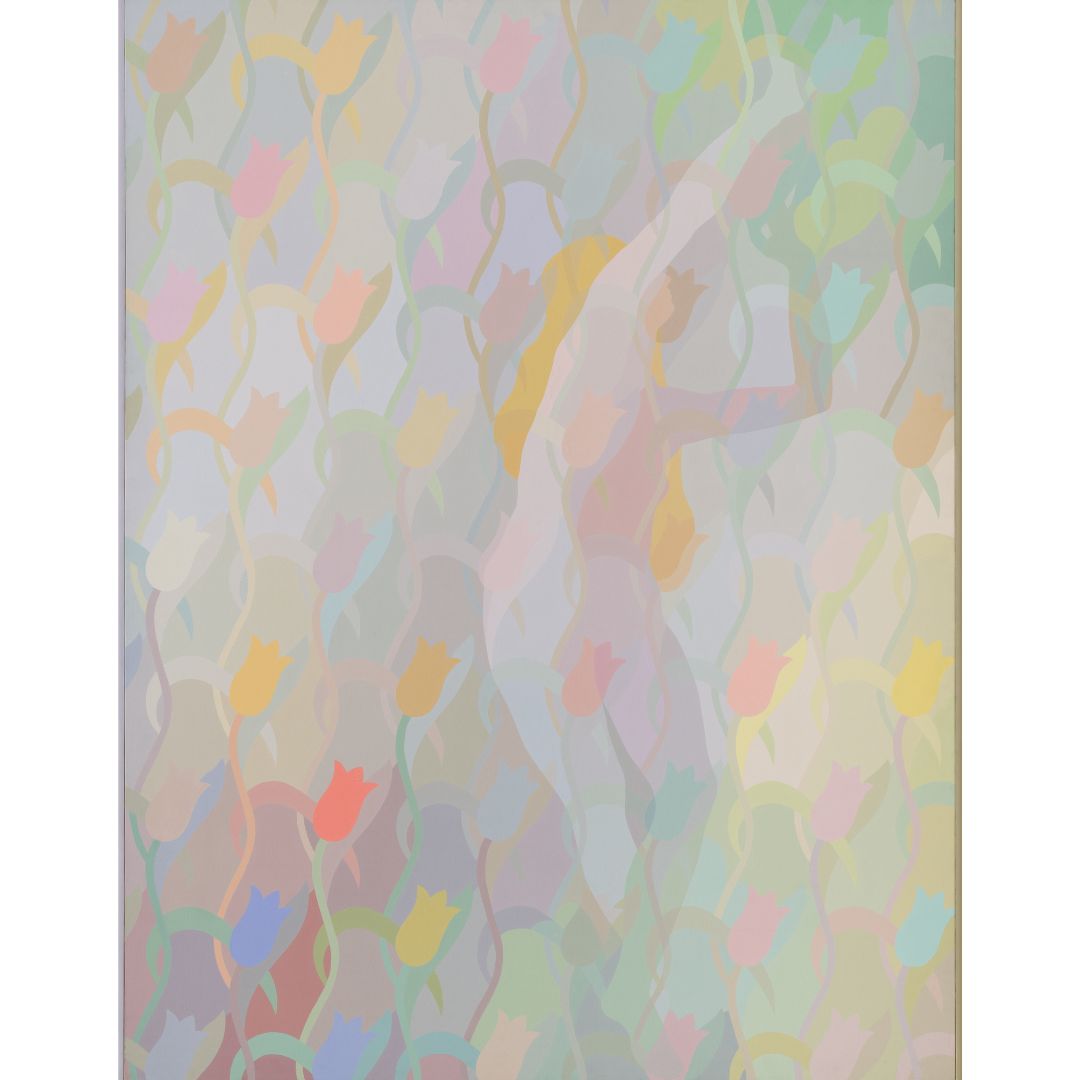
L to R: George Woodman. "Daphne," 1982, 78 x 60 in. Acrylic on canvas. Image courtesy DC Moore Gallery. Artwork © Woodman Family Foundation / Artists Rights Society (ARS), New York / Installation view, "Who Is There?", DC Moore Gallery, New York, 2024
George Woodman. "Daphne," 1982, 78 x 60 in. Acrylic on canvas. Image courtesy DC Moore Gallery. Artwork © Woodman Family Foundation / Artists Rights Society (ARS), New York.
ON VIEW: George Woodman in "Who Is There?", DC Moore Gallery, New York, 2024
This group exhibition of personal, expressive landscapes features works that merge abstraction and representation, depicting threshold spaces and hybridized forms where the observed and the imaginative meet.