


L to R: “Untitled,” c. 1977-78, 8 x 8 1/16 in. | “Untitled,” 1977, 5 5/16 x 5 3/8 in. | Installation view from ““Blur / Obscure / Distort: Photography and Perception,” Norton Museum of Art, West Palm Beach, Florida, 2025. Photo courtesy Norton Museum of Art. All gelatin silver prints. All artworks by Francesca Woodman © Woodman Family Foundation / Artists Rights Society (ARS), New York.
Francesca Woodman. “Untitled,” c. 1977-78, 8 x 8 1/16 in. Gelatin silver print © Woodman Family Foundation / Bildupphovsrätt i Sverige, Stockholm
ON VIEW: Francesca Woodman in "The Subterranean Sky: Surrealism in the Moderna Museet Collection" and “Blur / Obscure / Distort: Photography and Perception,” 2025
Works by Francesca Woodman are currently on view in two museum exhibitions about Surrealism and photography's relationship with truth at the Moderna Museet and Norton Museum of Art, respectively.

Betty Woodman. “Pillow Pitcher,” c. 1983, 17 1/4 x 20 1/2 x 14 1/2 in. Glazed earthenware. Promised Gift of David and Julianne Armstrong. Installation views from “Hot! & Ready to Serve: Celebrating Functional Ceramics,” American Museum of Ceramic Art, Pomona, California, 2025.
Installation view from “Hot! & Ready to Serve: Celebrating Functional Ceramics,” American Museum of Ceramic Art, Pomona, California, 2025.
ON VIEW: Betty Woodman in "Hot! & Ready to Serve: Celebrating Functional Ceramics," American Museum of Ceramic Art, Pomona, California, 2025
In honor of International Museum Day this past week, our Collections Coordinator Celia Lê visited AMOCA, where Betty Woodman’s "Pillow Pitcher" is on view alongside works by Ron Nagle, Paul Soldner, Peter Voulkos, among others in "Hot! & Ready to Serve."

L to R: 2: “Self Portrait,” 1976, 4 13/16 x 4 14/16 in. | 3: “From Polka Dots” or “Polka Dots,” 1976, from the “Polka Dots” series, 5 1/4 x 5 1/4 in. | 4: “Untitled,” 1979, 5 13/16 x 5 13/16 in. | 5: “Untitled,” c. 1975-76, 4 1/4 x 4 1/4 in. | 6: “Untitled,” 1978, 37 3/8 x 35 3/4 in. | 7: “Untitled,” 1980, 79 1/2 x 36 1/4 in. Lifetime diazotype | 8: “Some Disordered Interior Geometries,” c. 1980-81, 9 x 6 1/2 in. Found notebook with artist’s 16 lifetime gelatin silver print. 24 pages plus cover. All lifetime gelatin silver prints. All artworks by Francesca Woodman © Woodman Family Foundation / Artists Rights Society (ARS), New York
Group, artworks by Francesca Woodman © Woodman Family Foundation / Artists Rights Society (ARS), New York
Major acquisition by the Art Institute of Chicago
Thrilled to announce that the Art Institute of Chicago has acquired 30 important lifetime works by Francesca Woodman from the Foundation’s holdings. With the breadth and depth of this acquisition, the Art Institute now owns the largest institutional collection of the artist’s lifetime works and has become a major center for its preservation and public display.


Installation views, "George Woodman: A Democracy of Parts, Paintings 1966-1978," DC Moore Gallery, New York, New York, 2025
CLOSING: "George Woodman: A Democracy of Parts, Paintings 1966-1978," DC Moore Gallery, 2025
This week is your last chance to see George Woodman: A Democracy of Parts, Paintings 1966-1978, an exhibition tracing the development of Woodman’s singular approach to pattern and color over a series of paintings rarely shown in New York in more than 40 years.

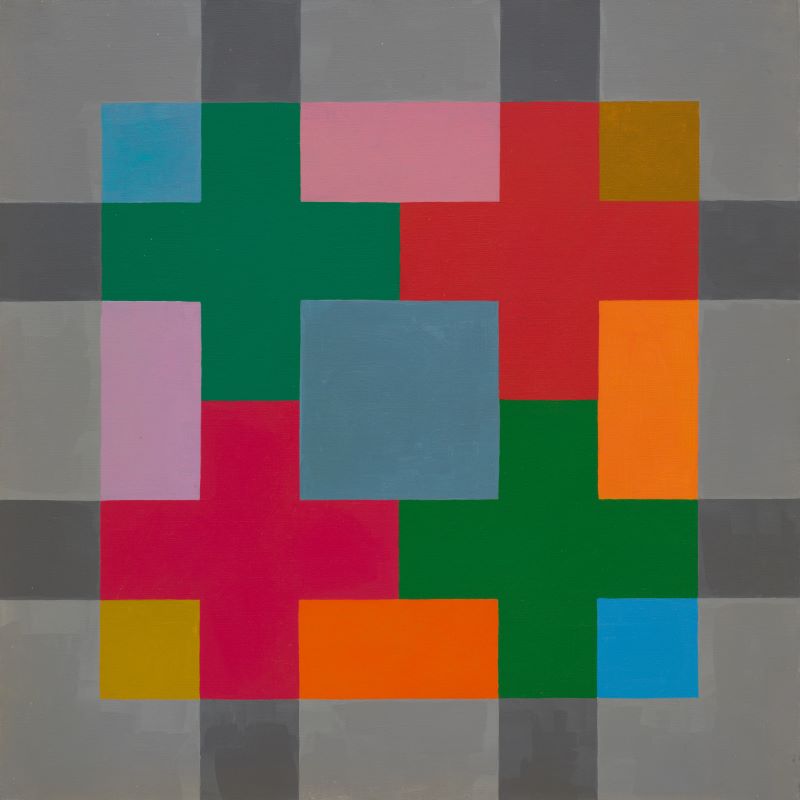
L to R: 1: “Untitled,” 1978, 49 x 49 in. Acrylic on canvas | 2: Installation view, “George Woodman: A Democracy of Parts, Paintings 1966-1978,” DC Moore Gallery, New York, New York, 2025 | 3: “Grey Portal,” 1978, 84 x 84 in. Acrylic on canvas | 4: “Untitled,” 1978, 48 x 48 in. Acrylic on canvas | 5-7: Installation views, “Three Paper Tilings,” Claremore College, Claremore, Oklahoma, 1979 | 8: Installation view, “Paper Tilings,” Denver Art Museum, Denver, Colorado, 1980 | 9: “Sentimental Geometry,” 1981, 120 x 252 in. Paper tiles. Installation view, “Criss-Cross at Yellowstone,” Yellowstone Art Center, Billings, Montana, 1981 | 10-11: “Rochester Carpet,” 1984. Hand-painted chipboard tile installation. Bevier Gallery, Rochester Institute of Technology, Rochester, New York, 1984. All artworks by George Woodman © Woodman Family Foundation / Artists Rights Society (ARS), New York. Woodman Family Foundation Archives.
George Woodman. “Untitled,” 1978, 49 x 49 in. Acrylic on canvas © Woodman Family Foundation / Artists Rights Society (ARS), New York
Aperiodic tiling. "George Woodman: A Democracy of Parts, Paintings 1966-1978," DC Moore Gallery, New York, 2025
By 1977, George Woodman’s tessellation paintings became non-periodic or aperiodic, consisting of a set of shapes which tiled the canvas but did not necessarily repeat.

L to R: 1: “Untitled,” c. 1970s, 72 x 108 in. Medium unknown | 2: Spread from “Criss-Cross Art Communications,” No. 6, published by Criss Cross Foundation, 1978 | 3: Various issues of “Criss-Cross Art Communications” | 4: “Untitled,” c. 1970s, dimensions and medium unknown | 5: “285” or “Bari” or “Winterreise,” 1975, 65 x 65 in. Acrylic on canvas | 6: “Tessellation Sky,” 1975, 54 1/2 x 54 1/2 in. Acrylic on canvas | 7: Spread from the exhibition catalogue for “19 Artists—Emergent Americans,” published by Solomon R. Guggenheim Museum, 1981 | 8-9: Installation views, “19 Artists—Emergent Americans,” Solomon R. Guggenheim Museum, New York, 1981 | 10: “Double Reflection,” 1970, 66 x 66 in. Oil on canvas. All artworks by George Woodman © Woodman Family Foundation / Artists Rights Society (ARS), New York. Woodman Family Foundation Archives.
George Woodman. “Untitled,” c. 1970s, 72 x 108 in. Medium unknown © Woodman Family Foundation / Artists Rights Society (ARS), New York
The Criss-Cross and Pattern & Decoration Movements. "George Woodman: A Democracy of Parts, Paintings 1966-1978," DC Moore Gallery, New York, 2025
By the mid-70s, George Woodman’s singular approach to pattern painting—as harmony between color and form—was well established and recognized among artists and critics alike. Woodman’s canvases were part of the larger zeitgeist around pattern in the art of this period.
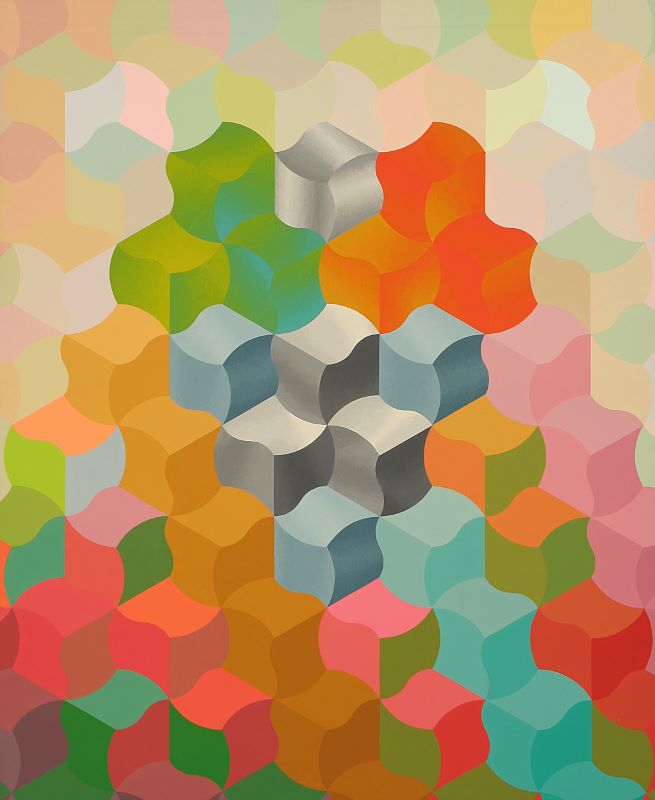
1: “Magic Mountain,” c. 1970, 66 x 54 in. Oil on canvas | 2: “Untitled,” 1969, 48 1/4 x 48 1/4 in. Acrylic on canvas | 3: “Cascade,” 1974, 36 x 36 in. Acrylic on canvas | 4: “Untitled,” 1974, 66 x 66 in. Acrylic and oil on canvas | 5: “Cloud,” 1969, 68 3/4 x 58 1/2 in. Oil on canvas | 6: “Untitled,” 1970, 54 1/4 x 54 1/4 in. Acrylic on canvas | 7: “Untitled,” c. 1974-76, 59 x 59 in. Acrylic on canvas | 8: “Color Octagon,” 1975, 83 x 83 in. Acrylic on canvas | 9: “Winterreise,” 1975, 85 x 85 in. Acrylic on canvas. All artworks by George Woodman © Woodman Family Foundation / Artists Rights Society (ARS), New York.
George Woodman. “Magic Mountain,” c. 1970, 66 x 54 in. Oil on canvas © Woodman Family Foundation / Artists Rights Society (ARS), New York
Idiosyncratic use of color. "George Woodman: A Democracy of Parts, Paintings 1966-1978," DC Moore Gallery, New York, 2025
Pattern paintings made up of repeating forms can tend towards uniformity or sameness, but not so for George Woodman. Instead, he integrated color into his pattern systems as an equal to form rather than a subordinate, constructing compositions in which color steers and complicates the viewer’s perception.
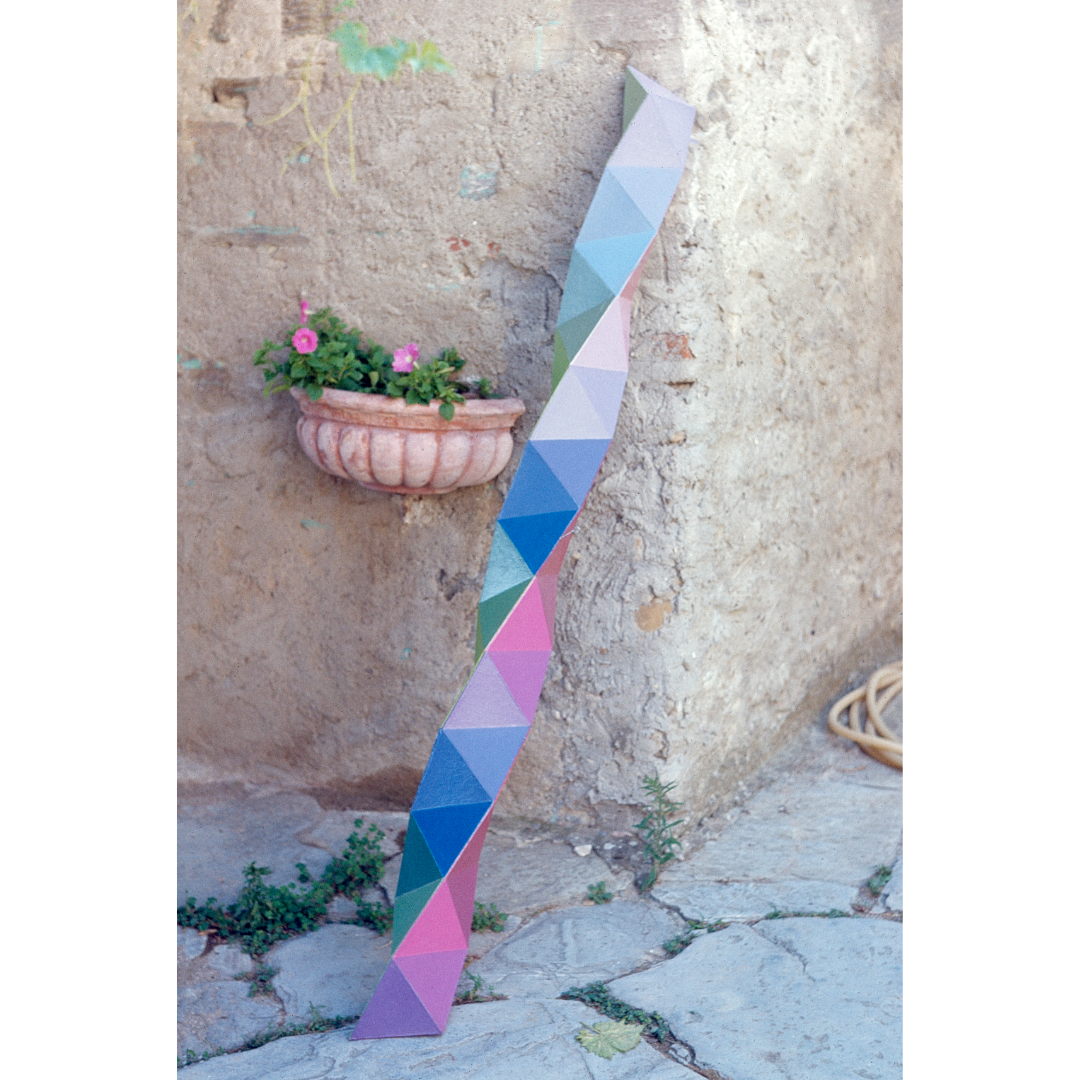
L to R: 1, 3, 5: “Untitled,” c. 1973-74 | 2: George Woodman with sculpture, Antella, Italy, c. 1970s | 4: “Untitled,” 1975, 60 x 60 in. Acrylic on canvas | 6: “5 Sided Column,” c. 1973 | 7: “Untitled,” c. 1973 | 8: “Untitled,” c. 1974 | 9-10: Photographed sketches and notes, undated | 11: “Untitled,” c. 1964. Pyramid-shaped painting suspended from a tree in Woodman’s backyard, Boulder, Colorado. All sketches and artworks by George Woodman © Woodman Family Foundation / Artists Rights Society (ARS), New York. Woodman Family Foundation Archives.
George Woodman. “Untitled,” c. 1973-74 © Woodman Family Foundation / Artists Rights Society (ARS), New York. Woodman Family Foundation Archives
George Woodman's geometric sculptures. "George Woodman: A Democracy of Parts, Paintings 1966-1978," DC Moore Gallery, New York, 2025
George Woodman’s tessellated pattern paintings built upon observations made in the three-dimensional realm of architecture, specifically in the tiled surfaces that covered walls and floors as they emerged from and receded into space.
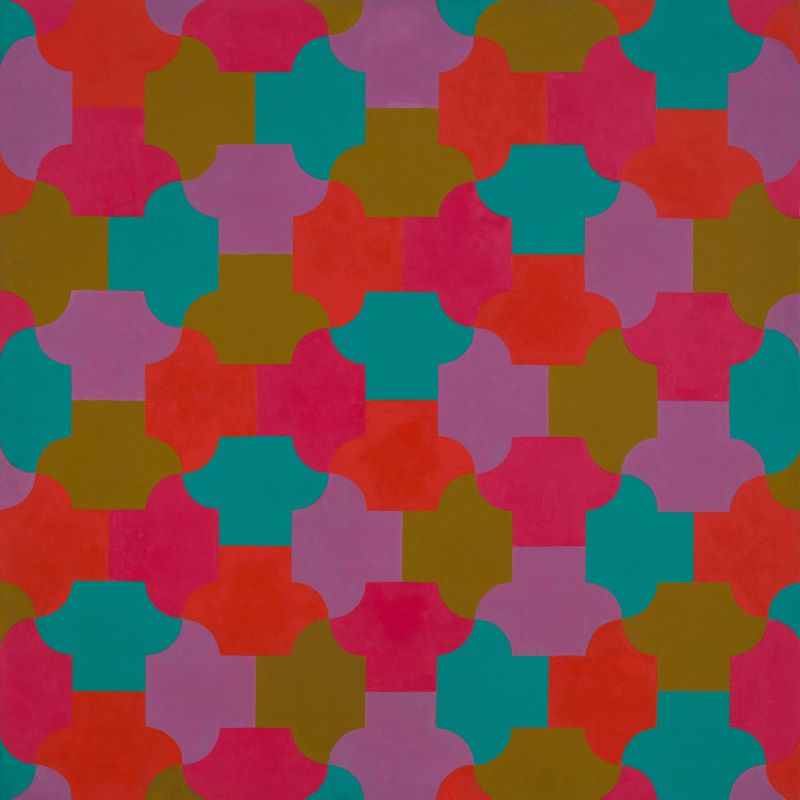
L to R: 1: “A Gentle Tessellation,” 1966/1968, 43 1/4 x 43 1/4 in. Acrylic on canvas | 2: “Pattern on Trapezoid,” 1967, 58 x 42 in. Acrylic on canvas | 3: Spread from “Award Winning Artists: Southeast and Southwest,” published by the National Council on the Arts and National Endowment for the Arts, 1968 | 4: “Untitled,” 1970, 96 x 134 in. Acrylic on canvas | 5: “Untitled,” c. 1966, dimensions & medium unknown | 6: George Woodman’s studio, Boulder, Colorado, c. 1967. Woodman Family Foundation Archives | 7: “Equivocal Hexagon,” 1967, 48 x 48 in. Acrylic on canvas | 8: “Untitled,” 1969, 48 1/4 x 48 1/4 in. Acrylic on canvas. All artworks by George Woodman © Woodman Family Foundation / Artists Rights Society (ARS), New York
George Woodman. “A Gentle Tessellation,” 1966/1968, 43 1/4 x 43 1/4 in. Acrylic on canvas © Woodman Family Foundation / Artists Rights Society (ARS), New York
George Woodman's tessellations. "George Woodman: A Democracy of Parts, Paintings 1966-1978," DC Moore Gallery, New York, 2025
Tessellations are a type of pattern in which one or more geometric shapes are repeated—and often rotated and reflected—to seamlessly cover a surface. In George Woodman’s case, that surface was a canvas.
L to R: 1: George Woodman, “Piazza San Francesco di Paola,” 1966, 32 x 32 in. Oil on canvas | 2: George Woodman, “Untitled,” 1964, 49 x 49 in. Oil on canvas | 3: George Woodman, “Untitled,” c. 1965, 57 x 68 in. Acrylic on canvas | 4: George Woodman, “Untitled,” 1967, 65 x 65 in. Oil on canvas | 5: George Woodman, “Rainbow Funnel,” c. 1967-69, 63 x 39 1/2 in. Acrylic on canvas | 6: George Woodman, Notes from a lecture on Sol LeWitt, c. 1976. Woodman Family Foundation Archives. | 7: George Woodman, Notes from a lecture on Pattern and Art, c. 1979. Woodman Family Foundation Archives. | 8: Sol LeWitt, “Wall Drawing 1: Drawing Series II 18 (A & B),” 1968, each 48 x 48 in. Graphite on wall. San Francisco Museum of Modern Art © The LeWitt Estate | 9: Sol LeWitt, “Cubic-Modular Wall Structure, Black,” 1966, 43 1/2 x 43 1/2 x 9 3/8 in. Painted wood. Museum of Modern Art © The LeWitt Estate | 10: Sol LeWitt, “Serial Project, I (ABCD),” 1966, 20 in. x 13 ft. 7 in. x 13 ft. 7 in. Baked enamel on steel units over baked enamel on aluminum. Museum of Modern Art © The LeWitt Estate | 11: Frank Stella, “Harran II,” 1967, 10 x 20 ft. Polymer on fluorescent polymer paint on canvas. Solomon R. Guggenheim Museum © Estate of Frank Stella | 12: Frank Stella, “Gray Scramble,” 1968-69, 69 x 69 in. Oil on canvas. Solomon R. Guggenheim Museum © Estate of Frank Stella | 13: Alfred Jensen, In-text plate (folio 13) from “A Pythagorean Notebook,” 1965, 15 9/16 × 20 11/16 in. Composition from illustrated book with 20 lithographs, published by Tamarind Lithography Workshop. Museum of Modern Art © Estate of Alfred Jensen | 14: Alfred Jensen, “That Is It,” 1966, 42 x 36 in. Oil on canvas. Museum of Modern Art © Estate of Alfred Jensen | 15: Alfred Jensen, “The Acrobatic Rectangle Per, Eleven,” 1967, 68 x 48 1/2 in. Oil on canvas. Whitney Museum of American Art © Estate of Alfred Jensen | 16: Agnes Martin, “Orchards of Lightning,” 1966, 11 3/4 x 9 3/8 in. Ink on paper. Museum of Modern Art © Estate of Agnes Martin | 17: Agnes Martin, “Untitled,” 1963, 8 x 8 in. Brush and ink and pen and ink on paper. Whitney Museum of American Art © Estate of Agnes Martin | 18: Agnes Martin, “Untitled,” 1960, 70 x 70 in. Oil on canvas. Dia Art Foundation © Estate of Agnes Martin. All George Woodman artworks © Woodman Family Foundation. All artworks © Artists Rights Society (ARS), New York
George Woodman, “Piazza San Francesco di Paola,” 1966, 32 x 32 in. Oil on canvas © Woodman Family Foundation / Artists Rights Society (ARS), New York
George Woodman in dialogue with New York minimalist painters. “George Woodman: A Democracy of Parts, Paintings 1966-1978,” DC Moore Gallery, New York, 2025
In her essay for the exhibition’s catalogue—“The Mind as it Measures: George Woodman’s Patterns”—curator Rebecca Skafsgaard Lowery discusses Woodman’s approach to pattern and color in the context of his contemporaries.

L to R: 1: George Woodman, Alhambra, Granada, Spain, c. 1965 | 2, 5, 9: Tile patterns in Alhambra, Granada, Spain, 1965 | 3: “7 Colors in 4’s,” 1966, 67 x 67 in. Acrylic on canvas | 4: Alhambra Palace baths, Granada, Spain. Photo © Guido Montanes Castillo | 6: “Untitled,” 1966, 66 1/2 x 66 1/2 in. Oil on canvas | 7: Sketch for painting, c. 1965-66 | 8: “San Francisco di Paolo” or “Axe Pattern,” 1966, 43 x 43 in. Acrylic on canvas | 10: Charles Woodman and Francesca Woodman, Alhambra, Granada, Spain, c. 1965 | 11: Betty Woodman, Alhambra, Granada, Spain, c. 1965. All artworks, sketches, and photos by George Woodman © Woodman Family Foundation / Artists Rights Society (ARS), New York. Woodman Family Foundation Archives.
George Woodman, Alhambra, Granada, Spain, c. 1965. Woodman Family Foundation Archives.
George Woodman's travels to Alhambra, Granada, Spain. "George Woodman: A Democracy of Parts, Paintings 1966-1978," DC Moore Gallery, New York, 2025
In 1965, George Woodman visited Granada, Spain to see the Alhambra, the iconic monument to Islamic architecture where geometry, ornamentation and architecture harmoniously converge in a multitude of tiled and carved surfaces.

L to R: 1: George Woodman’s studio, Tuscany, Italy, c. 1965-66 | 2: “Untitled,” 1965, 63 x 94 in. Oil on canvas | 3: “Untitled,” 1967, 31 3/4 x 31 3/4 in. Oil on canvas. Image courtesy Simone Begani | 4: “Untitled,” c. 1965-66, dimensions unknown. Oil on canvas | 5: “Untitled,” c. 1966, 40 x 40 in. Oil on canvas | 6: “Cosmati,” 1966, 60 x 60 in. Oil on canvas | 7: Cosmati tile detail Cattedrale di Anagni, Anagni, Italy © Museo della Cattedrale di Anagni | 8: “Untitled,” c. 1966, 59 1/2 x 59 in. Oil on canvas | 9: Sketch for painting, c. 1965-66 | 10: “Trajan’s Column,” 1965/1966, 33 1/2 x 201 in. Acrylic on canvas | 11: Sketch for painting, undated | 12-14: Details from “Trajan’s Column,” 1965/1966 | 15: Exhibition announcement, “George E. Woodman: The Italian Paintings,”University Memorial Center Art Gallery, University of Colorado, Boulder, Colorado, 1966. All sketches and artworks by George Woodman © Woodman Family Foundation / Artists Rights Society (ARS), New York. Woodman Family Foundation Archives.
George Woodman’s studio, Tuscany, Italy, c. 1965-66. Artworks by George Woodman © Woodman Family Foundation / Artists Rights Society (ARS), New York. Woodman Family Foundation Archives.
George Woodman's year in Florence, Italy. "George Woodman: A Democracy of Parts, Paintings 1966-1978," DC Moore Gallery, New York, 2025
From the fall of 1965 through the summer of 1966, George Woodman spent the year living and working near Florence, Italy. It was in this year that the presence of pattern and attention to color that characterized his earlier paintings took a definitive turn.